
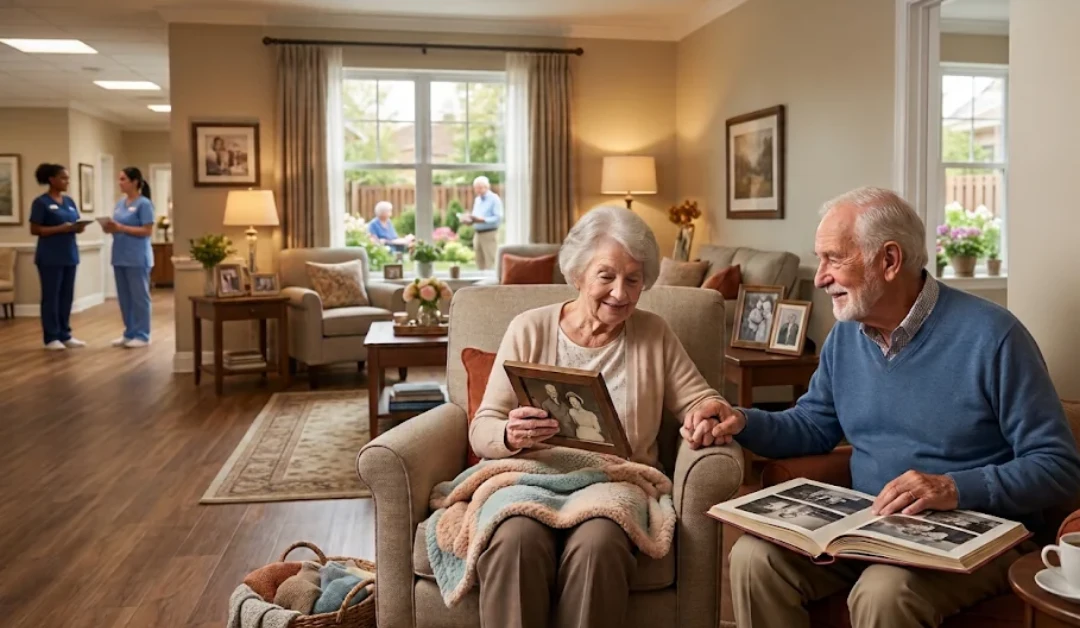
When one spouse needs memory care, couples and their families often face a difficult question: Does moving into memory care mean they have to live apart?
Not necessarily. Some senior living communities may allow spouses to share an apartment or offer separate residences within the same community. However, these arrangements are not available everywhere. Whether a couple can live together depends on each person’s support needs, the community’s admission and occupancy policies, room availability, and whether the arrangement can accommodate both spouses.
For some couples, sharing an apartment may be an option. For others, living in different care settings on the same campus may be a better fit. Living at separate nearby communities is another possibility.
Understanding these options before deciding can help families compare memory care arrangements based on more than whether two people can share a room.
Are Couples Allowed to Live Together in Memory Care?
Sometimes, yes. A spouse may be able to live in the same memory care apartment as their partner, but the community must first confirm that it permits shared occupancy and can accommodate both individuals.
Memory care is generally organized around residents who need a particular level of memory-related support. A spouse who does not need that same support may not automatically qualify to live in the secured memory care area.
Before considering a shared arrangement, ask the community to evaluate each spouse separately. A levels of care assessment can help families understand each person’s individual care requirements and identify the level of support that may be appropriate. The discussion should cover:
- Admission eligibility: Does the community allow a spouse who does not require memory care to live in the memory care neighborhood?
- Individual support needs: What assistance does each person need throughout the day and overnight?
- Room availability: Are apartments or suites designed and approved for two occupants?
- Privacy and personal preferences: Can both spouses maintain comfortable sleeping arrangements, personal space, and daily routines?
- Community policies: Are there occupancy, safety, or licensing requirements that affect the proposed arrangement?
A community’s willingness to accommodate couples should be confirmed for the specific residents and apartment being considered. A general statement that it accepts couples is not the same as approval for a particular living arrangement.
Can Married Couples Share a Room or Apartment in Memory Care?
Some communities may offer shared apartments or suites, but families should not assume that every memory care community has this option.
A shared apartment may be considered when the community can accommodate both spouses and each person is comfortable with the arrangement. The room also needs to provide enough space and suitable facilities for two residents.
Before choosing this option, discuss the following:
- Separate support arrangements: Each spouse should have their own understanding of what assistance is available and what services are included. One partner should not be expected to take responsibility for the other’s care simply because they share an apartment.
- Sleeping arrangements: Ask whether the room has enough space for both people to sleep comfortably and whether different sleep schedules can be accommodated.
- Personal space: Consider whether each spouse can have privacy, store personal belongings, and spend time independently when needed.
- Changing needs: Find out what happens if one spouse later needs more assistance or the shared arrangement no longer works for either person.
- Room availability and occupancy: Confirm that the exact apartment can accommodate two people under the community’s policies.
A shared room may be convenient, but it should not be treated as the only way for couples to remain connected.
When Might Sharing a Memory Care Apartment Not Be Suitable?
Even when a couple wants to live together, sharing an apartment may not be the most appropriate arrangement.
The decision should consider both spouses’ preferences and the practical requirements of the living environment. Some circumstances that may make a shared apartment difficult include:
- Different levels of support: One spouse may need assistance or supervision that the shared arrangement cannot accommodate.
- Different daily routines: Sleeping schedules, personal habits, and preferred activities may make sharing one space uncomfortable.
- Privacy concerns: Either spouse may prefer a separate bedroom or personal living area.
- Room limitations: The available apartment may not have enough space or facilities for two occupants.
- Community restrictions: The community may not permit a spouse who does not meet its memory care admission criteria to live in that area.
- Changing circumstances: An arrangement that works initially may need to be reconsidered if either person’s needs or preferences change.
There is no single arrangement that works for every couple. Families should ask the community to explain why a shared apartment is or is not available and what alternatives it can offer.
What Are the Living Options When Only One Spouse Needs Memory Care?
When one spouse needs memory care, and the other does not, couples may have several possible arrangements. The right option depends on what each person needs and what the community can accommodate.
1. One spouse lives in memory care and the other in assisted living
Some senior living communities offer assisted living and memory care in separate areas of the same location.
This may allow one spouse to receive memory-related support while the other lives in assisted living. Each person has a living arrangement suited to their individual needs, while the couple may still be able to spend time together.
Ask whether residents from different care areas can:
- Visit each other’s apartments or neighborhoods.
- Share meals in designated dining areas.
- Attend activities or community events together.
- Spend time in shared indoor or outdoor spaces.
- Arrange visits when one spouse needs assistance getting between areas.
Do not assume that being on the same campus automatically means unrestricted access. Ask how visits actually work, including evenings, weekends, and times when staff assistance may be needed.
2. One spouse lives in memory care and the other in independent living
If the spouse without memory-related support needs to maintain a more independent lifestyle, independent living may be another option where available.
The couple would have separate residences and different daily arrangements. Their ability to spend time together would depend on the community’s visiting policies, distance between residences, transportation, and available shared spaces.
This arrangement may be worth discussing when one spouse does not need assisted living services but wants to remain close.
3. Each spouse lives at a different nearby community
Not every community offers independent living, assisted living, and memory care in one location. In that situation, separate nearby communities may be an alternative.
Families should consider the actual travel time between residences, transportation availability, visiting hours, and whether the couple can maintain a realistic routine for spending time together.
A nearby location may sound convenient on paper, but the practical details matter. Ask who will arrange transportation and whether either spouse will need help traveling between the two residences.
Can a Couple Stay on the Same Campus if One Spouse Needs a Higher Level of Care Later?
Possibly, but families should not assume that choosing a community with multiple care settings guarantees that both spouses can remain there indefinitely.
A community may offer different living options, but the availability of a particular apartment, care setting, or service can change. Admission requirements and the support a community can provide may also affect future arrangements.
Before moving, ask:
- What happens if the spouse in assisted living later needs memory care?
- Can the spouse already living in memory care remain in their current residence?
- Can either person move to another care area without requiring the other spouse to move?
- Are transfers based on an assessment, availability, or both?
- What happens if the community cannot accommodate one spouse’s changing needs?
- Would a move to another location affect the other spouse’s residence or agreement?
Ask for the community’s actual process, not just a general assurance that it offers multiple levels of care. If future flexibility is important to the couple, request written clarification about what is and is not guaranteed.
How Much Does Memory Care Cost for a Couple?
The cost depends on the living arrangement, the community’s pricing structure, and the services each spouse requires. There is no single standard price for couples living in memory care.
A shared apartment may have a different pricing structure from two separate residences. Some communities charge an additional occupancy fee, while others calculate housing and services separately for each resident. Understanding typical memory care costs can help families compare these expenses.
When comparing costs, ask about:
- Apartment or room charges: Is the quoted housing price for one person or two?
- Second-person fees: Is there an additional charge for a spouse sharing the apartment?
- Individual care charges: Are support services priced separately for each resident?
- Separate residences: What would the combined monthly cost be if one spouse lives in memory care and the other in assisted or independent living?
- Additional services: Are transportation, personal assistance, or other services billed separately?
- Future changes: How could the monthly amount change if either spouse moves to another care setting?
For a fair comparison, request an itemized estimate for both spouses under at least two arrangements: sharing one residence, if permitted, and living in separate care settings.
Compare the total monthly cost for the couple, not just the advertised starting price for one resident. Also ask which charges may change over time and how the community communicates those changes.
How Can Couples Stay Connected if They Live in Separate Care Areas?
Living in separate apartments or care areas does not necessarily mean a couple has to give up everyday time together. The important thing is to understand what opportunities the community can realistically support.
Depending on the community’s policies and each person’s preferences, couples may be able to maintain familiar routines such as:
- Sharing breakfast, lunch, or dinner.
- Spending time together in common areas or outdoor spaces.
- Attending selected activities or community events.
- Celebrating birthdays, anniversaries, and family occasions together.
- Having planned visits during the day.
- Spending quiet time together in an appropriate shared space.
Families should ask about the practical details behind these possibilities. For example, can the spouse living outside memory care visit independently? Is staff assistance required to arrange visits? Can meals be shared, and are there additional charges?
It is also worth discussing what happens when one spouse cannot travel between care areas independently. A plan that relies on frequent visits should account for the assistance and arrangements needed to make those visits possible.
What Should Families Ask Before Choosing Memory Care for a Couple?
When comparing communities, families should ask questions about the couple’s current living arrangement and what could happen if their needs change.
Use this checklist during calls and community visits.
Questions about sharing an apartment
- Do you allow married couples to share a memory care apartment or suite?
- Can a spouse who does not need memory care live in the same apartment?
- What admission, occupancy, or assessment requirements apply to each spouse?
- Are shared apartments currently available, and can we see the specific room?
- Are housing and care charges calculated separately for each person?
Questions about separate living arrangements
- Can one spouse live in assisted living or independent living while the other lives in memory care on the same campus?
- How do residents visit each other across different care areas?
- Can spouses share meals, attend activities, and use common spaces together?
- Is staff assistance or transportation available when one spouse needs help visiting the other?
- Are there nearby alternatives if the community cannot accommodate both spouses?
Questions about future changes and costs
- What happens if one spouse needs a different living arrangement later?
- Can one spouse move to another care area without requiring the other to move?
- What circumstances could make the current arrangement unavailable?
- Can we receive written estimates showing the combined monthly cost for both spouses?
- Which parts of the proposed arrangement are confirmed, and which depend on future availability or reassessment?
A useful final question to ask is: “If our living arrangements need to change, what specific options could help us continue spending time together?”
Ask the community to explain its answer using realistic examples and, where possible, include important details in the written agreement. This helps families distinguish between arrangements currently available and possibilities that are not guaranteed.
Frequently Asked Questions
Can a spouse live in memory care if they do not have dementia?
Possibly, but it depends on the community’s admission and occupancy policies. Some communities may consider a spouse who does not need memory care for a shared apartment, while others may not permit it. Ask whether the spouse can be accepted into the specific memory care setting and what requirements apply.
Do all memory care communities offer rooms for married couples?
No. Shared apartments or suites are not available at every community. Room availability, occupancy policies, apartment layouts, and each spouse’s needs can affect whether a shared arrangement is possible.
Is it better for spouses to live together or in separate care areas?
Neither arrangement is automatically better. Sharing an apartment may suit couples who are both comfortable with the arrangement and can be accommodated by the community. Separate care areas may be more appropriate when their living preferences or support needs differ.
Can a spouse visit their partner in memory care whenever they want?
Visiting arrangements vary by community. Ask about visiting hours, access procedures, staff assistance, and whether a spouse living in another care area can visit independently. Confirm how the policy works during evenings, weekends, and special occasions.
Some communities may allow spouses in different care areas to share meals, but the arrangements depend on their policies and available dining options. Ask where meals can be shared, whether advance arrangements are needed, and whether any additional charges apply.
Does a couple pay one monthly fee when sharing a memory care apartment?
Not necessarily. A community may charge a second-person fee, separate care charges, or a combination of housing and individual service fees. Request an itemized estimate showing the total monthly amount for both spouses.
What if one spouse can no longer stay in the same apartment?
The community may recommend a different arrangement based on its policies, available residences, and each person’s needs. Before moving in, ask what options may be available if shared occupancy is no longer possible and whether the other spouse can remain in the same community.
Should couples look at memory care options before they need to move?
Starting conversations early can give couples and their families more time to understand admission requirements, compare living arrangements, review costs, and ask about future changes. It also allows them to discuss how they would like to stay connected if separate residences become necessary.
Finding Memory Care Options for Couples in North Texas
When one spouse needs memory care, choosing a living arrangement involves more than finding an available room. Families may need to compare shared apartments, separate care settings, nearby residences, visiting arrangements, and the combined cost for both spouses.
New Day Lifestyle for Seniors helps families in North Texas understand senior living options and identify communities that may fit their circumstances. The guidance is provided at no cost or obligation to families.
If you are comparing memory care arrangements for yourself and your spouse or helping your parents plan for different care needs, we can help you discuss the available options and the questions worth asking before making a decision.