
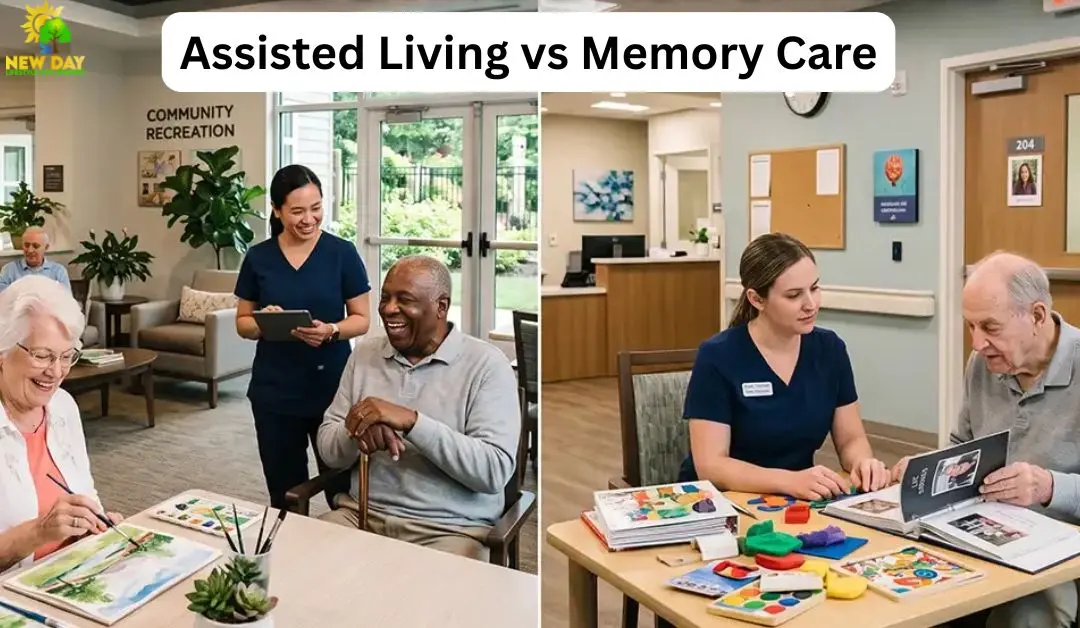
If you’re trying to sort out assisted living vs memory care for a parent or spouse, you’re probably doing it at the worst possible time, after a fall, a frightening diagnosis, or a phone call that made it clear things can’t stay the way they are.
That’s normal. Most families don’t research senior care until they’re already in the middle of a crisis, and the terminology doesn’t make it any easier. Assisted living and memory care sound similar, get used interchangeably in casual conversation, and are often located in the very same building.
But they are not the same thing, and choosing the wrong one can mean a loved one doesn’t get the supervision they need, or pays for services they don’t need.
This guide walks through what separates the two, who tends to do well in each setting, and how to recognize when a higher level of support has become necessary. Our goal is to give you a clear, honest comparison you can use regardless of where you ultimately turn for help.
What Is Assisted Living?
Assisted living is designed for older adults who need help with some daily tasks but are still largely independent. Residents typically live in their own apartment or suite and receive support with what are called Activities of Daily Living (ADLs), bathing, dressing, medication reminders, mobility, and similar needs, while maintaining a private, self-directed lifestyle.
A typical assisted living community includes:
- Private or semi-private apartments
- Meals are served in a communal dining room
- Housekeeping and laundry services
- Medication management or reminders
- Help with bathing, dressing, and grooming as needed
- Transportation to appointments and errands
- Social activities, fitness classes, and outings
- 24-hour staff availability, though not necessarily clinical staff
The defining feature of assisted living is autonomy. Residents come and go largely on their own schedule, often keep a car, and make their own day-to-day decisions. Staff are there to assist, not to manage every aspect of a resident’s life.
This makes assisted living a strong fit for seniors who are dealing with the physical slowdowns of aging, arthritis, reduced strength, and vision changes, but whose judgment, memory, and ability to recognize danger remain intact.
What Is Memory Care?
Memory care is a specialized form of senior living built specifically for people living with Alzheimer’s disease, dementia, or other forms of significant cognitive decline. While many memory care neighborhoods exist within a larger assisted living or senior living campus, the environment, staffing, and daily structure are fundamentally different.
Memory care communities are designed around one central fact: residents may not be able to recognize danger, remember instructions, or find their way back to their room. Every part of the environment reflects that.
Common features of memory care include:
- Secured entrances and exits to prevent unsafe wandering.
- Smaller, more intimate living areas with simplified layouts.
- Staff trained specifically in dementia care techniques and behavioral support.
- Structured daily routines that reduce confusion and anxiety.
- Activities designed around cognitive ability, not just entertainment (music therapy, sensory activities, reminiscence programs).
- Higher staff-to-resident ratios.
- 24-hour supervision with staff trained to de-escalate agitation or confusion.
- Visual cues, color-coded hallways, and memory boxes outside resident doors to support orientation.
Memory care isn’t simply assisted living with extra locks. It’s a completely different model of care built around the unpredictable, progressive nature of dementia, where the goal is to preserve dignity and quality of life even as cognitive ability declines.
Assisted Living vs Memory Care: Key Differences
Understanding the difference between assisted living and memory care comes down to a handful of core categories: who the setting serves, how much medical and behavioral support is built in, and what daily life actually looks like.
| Category | Assisted Living | Memory Care |
| Purpose | Support independence with daily tasks | Specialized care for dementia and cognitive decline |
| Ideal Residents | Seniors who are mobile and cognitively intact but need help with ADLs | Seniors with Alzheimer’s, dementia, or significant memory loss |
| Medical Needs | Light to moderate; medication reminders, mobility support | Often higher: behavioral monitoring, fall risk, wandering risk |
| Dementia Support | Limited; not designed for advancing dementia | Core focus of the entire program |
| Safety Features | Standard building safety, emergency call systems | Secured/locked entrances, alarmed doors, enclosed outdoor spaces |
| Staff Training | General caregiving training | Specialized dementia and behavioral care training |
| Activities | Social, recreational, fitness-based | Structured, cognition-focused, sensory, and reminiscence-based |
| Cost | Lower; national median around $5,419–$6,200/month | Higher; national median around $6,690–$7,645/month |
This table captures the broad strokes, but the real-world answer for any one family usually comes down to a single question: can this person still recognize and respond to danger? If the answer is consistently no, that’s the line where memory care stops being a preference and becomes a safety issue.
Who Should Choose Memory Care?
Memory care becomes the appropriate choice when cognitive decline starts to affect safety, not just convenience. This is generally the right setting for seniors who:
- Have a diagnosis of Alzheimer’s disease or another form of dementia
- Have wandered, gotten lost, or left the stove on and forgotten about it
- Show increasing confusion about time, place, or familiar people
- Experience agitation, sundowning, or behavioral changes in the evening
- Can no longer manage medications, even with reminders
- Need consistent supervision throughout the day and night
- Have become unsafe living alone or in a standard assisted living setting
The Alzheimer’s Association estimates that an estimated 7.4 million Americans age 65 and older are living with Alzheimer’s in 2026, and about 1 in 9 people age 65 and older has Alzheimer’s. That means the question of who needs memory care is one that a large number of North Texas families will eventually face, often without much warning.
Can Someone Transition from Assisted Living to Memory Care?
Yes, and it’s one of the most common transitions in senior living. Many seniors move into assisted living while they’re still cognitively healthy, and over months or years, mild memory lapses progress into something more serious. When that happens, most communities and most families recognize that a move to memory care is in the resident’s best interest.
A few things to know about this transition:
- It’s rarely sudden. Families usually notice a gradual shift: more missed medications, repeated questions, getting lost on a familiar walk, or increased anxiety.
- Many communities offer both levels of care on one campus, which can make the move less disruptive since the resident stays in a familiar environment with familiar staff.
- Reassessments are normal. Reputable communities periodically evaluate residents’ cognitive and physical status and will flag when a higher level of care is needed. This isn’t a failure on the family’s part; it’s the system working as intended.
- Earlier transitions are usually smoother. Moving before a crisis (a fall, an elopement, a dangerous incident) tends to go better than moving after one, both emotionally and logistically.
If your loved one is currently in assisted living and you’re starting to wonder whether it’s still the right fit, that instinct is worth paying attention to.
How Much Does Memory Care Cost Compared to Assisted Living?
Cost is one of the first questions every family asks, and for good reason; this is a significant, ongoing expense. Based on 2026 national data:
- Assisted living has a national median cost of roughly $5,419 per month, though CareScout’s survey puts the national median closer to $6,200 per month, depending on methodology and region.
- Memory care runs notably higher, with a national median around $6,690 per month, and other industry estimates placing the national average closer to $7,645 per month, roughly 15 to 25% more than standard assisted living.
So when families ask about memory care vs assisted living cost, the honest answer is: expect to pay more for memory care, generally in the range of several hundred to over a thousand dollars more per month, depending on your market and the level of care required.
Understanding the Bill: Coverages & Payment Alternatives
- The Breakdown: Memory care costs are higher than assisted living because residents need specialized staff, enhanced security, and more hands-on support.
- The Medicare Rule: Medicare does not cover memory care or assisted living costs when care is provided in a residential setting. It only covers specific clinical medical services, short-term skilled nursing stays, or hospice care.
- Financial Alternatives: Since Medicare won’t cover long-term room and board, most families piece together funding using:
- Private Pay: Utilizing personal savings, retirement accounts, pensions, or liquidating assets like selling the family home.
- Long-Term Care Insurance: Private policies that explicitly cover adult day care, assisted living, or memory care services.
- VA Aid & Attendance Benefits: A specialized, tax-free monthly pension for wartime veterans and their surviving spouses that can significantly offset senior living costs.
While Medicare is out of the picture for room and board, Medicaid may cover the care components of assisted living or memory care in certain states. However, programs vary wildly by region, and not all communities accept Medicaid waivers, so checking local state guidelines is essential.
Signs It’s Time to Consider Memory Care
Knowing when memory care is needed often comes down to recognizing patterns rather than one single event. Consider memory care if you’re noticing:
- Wandering or getting lost, even in familiar places like their own neighborhood
- Leaving the stove, oven, or appliances on, repeatedly
- Missing or doubling up on medications, even with reminders in place
- Increasing confusion about time, place, or people, including not recognizing family members
- Personality or behavioral changes, such as new aggression, paranoia, or withdrawal
- Sundowning: increased agitation or confusion in the late afternoon and evening
- Difficulty managing personal hygiene that wasn’t a problem before
- Unsafe driving or decision-making that puts them or others at risk
- Caregiver burnout: if a spouse or family caregiver is exhausted and unable to provide adequate supervision
No single sign automatically means memory care is necessary, but a pattern of several together, especially anything involving wandering, fire risk, or medication errors, is a strong signal that the current setting may no longer be safe.
How to Decide Which Option Is Right
If you’re still unsure after reading through the differences, these questions can help clarify the decision:
- Can they recall what day or season it is, and does it matter to their safety if they can’t?
- Have they ever wandered off or gotten lost, even briefly?
- Can they manage medications safely with reminders, or do they need someone to administer them?
- Do they have a formal diagnosis of dementia, Alzheimer’s, or a related condition?
- Is a spouse or family member currently providing supervision that’s becoming unsustainable?
- Has a doctor or geriatric care manager recommended a specific level of care?
A geriatric care assessment from a physician, neurologist, or geriatric care manager can also provide an objective, clinical perspective, which is often more reliable than family judgment alone, especially when emotions and guilt are part of the equation.
Need Help Choosing Between Assisted Living and Memory Care?
Reading about the differences on paper is one thing. Standing in your parents’ kitchen, trying to decide whether what you just saw was a bad day or a sign of something more serious, is another. Every senior’s situation is layered with details a checklist can’t fully capture: their personality, their health history, their finances, and what they actually want for themselves.
This is where New Day Lifestyle for Seniors comes in. Our team works with families throughout McKinney, Frisco, Allen, Plano, Prosper, Celina, Melissa, and the surrounding North Texas communities to help sort through the options Assisted Living, Memory Care, Independent Living, Retirement Communities, and Residential Care Homes, based on the things that actually matter to your family: your loved one’s current care needs, your budget, their lifestyle, and where they’d want to be located.
We don’t run the communities ourselves, which means our guidance isn’t tied to filling any particular building. Instead, we get to know your situation, identify which communities in the area genuinely fit, and help you compare them side by side, all at no cost to your family.
If you’re trying to figure out whether assisted living or memory care makes more sense for someone you love, we’re glad to talk it through with you, no pressure and no obligation.
Frequently Asked Questions
1. Does Medicare cover the cost of assisted living or memory care?
No. Medicare does not cover long-term room and board for either option; it only covers specific medical services, therapies, or hospice care.
2. What is the main difference between the two options?
Assisted living focuses on physical assistance while preserving personal autonomy, whereas memory care provides specialized, 24/7 supervision in a secure environment for cognitive safety.
3. How much more expensive is memory care than assisted living?
Memory care generally costs 15% to 25% more than assisted living, typically adding several hundred to over a thousand dollars to the monthly bill.
4. Do I need a formal doctor’s diagnosis to enroll a loved one in memory care?
Yes. Communities require a physician’s clinical assessment confirming a dementia or Alzheimer’s diagnosis to legally admit a resident into a secured memory care unit.
5. Can a veteran get help paying for these senior living options?
Yes. If the resident or their spouse served during wartime, they may qualify for the VA Aid and Attendance benefit to help offset monthly costs.
Making the Right Choice for Your Peace of Mind
The line between assisted living vs memory care isn’t about which one sounds nicer or which building looks newer; it’s about matching the level of supervision and support to what your loved one actually needs to stay safe. Assisted living is built for seniors who need a hand with daily tasks but still think and reason clearly. Memory care is built for seniors whose cognitive decline has reached a point where safety, structure, and specialized support are no longer optional.
Getting this decision right matters, both for your loved one’s well-being and your own peace of mind. If you’re still weighing the options, take the time to tour communities, ask detailed questions about staffing and safety, and don’t hesitate to bring in a professional opinion, whether that’s a physician or a local senior living advisor who knows the North Texas market.