

Choosing a senior living arrangement involves more than finding a comfortable place to live. Families also need to consider how a senior’s housing and support needs may change over time. A person who lives independently today may eventually need help with daily activities, memory-related support, or skilled nursing care.
A Continuing Care Retirement Community (CCRC) is designed to address these changing needs by combining different levels of senior housing and care within one community or through coordinated care arrangements. Also known as a Life Plan Community, a CCRC typically offers independent living, assisted living, and access to nursing care under a continuing care agreement.
For Texas families comparing senior living options, understanding how CCRCs work, what they cost, and what their contracts include can help make long-term decisions more informed.
How Does a Continuing Care Retirement Community (CCRC) Work?
A Continuing Care Retirement Community (CCRC) is a senior living arrangement that combines housing with access to different levels of care as residents’ needs change. Many CCRCs operate on a single campus with independent living apartments or cottages, assisted living accommodations, and skilled nursing services. Some also provide memory care or coordinate additional services through affiliated providers.
Also known as Life Plan Communities, CCRCs are designed to help older adults plan for potential future care needs while maintaining an independent lifestyle for as long as possible.
For example, an older adult may initially move into an independent living apartment while managing daily routines without assistance. Several years later, if they need help with bathing or dressing, they may transition to assisted living if the community offers that service and they meet its admission requirements. If their needs eventually require skilled nursing, the CCRC may provide access to nursing services under the terms of the continuing care agreement.
This is an example of continuing care: a resident can access different levels of housing and support as their needs change over time.
However, not every CCRC provides all care services directly on its campus. Some arrange services through affiliated providers or outside healthcare organizations. Access to future care may also depend on contract terms, eligibility requirements, service capacity, and community policies. A CCRC agreement does not automatically guarantee immediate placement in every care setting.
Families should confirm which services are available, where they are provided, and what the continuing care agreement actually guarantees before signing a contract. The continuing care retirement communities information from the Administration for Community Living also explains how these communities operate.
What Levels of Care Do Continuing Care Retirement Communities Provide?
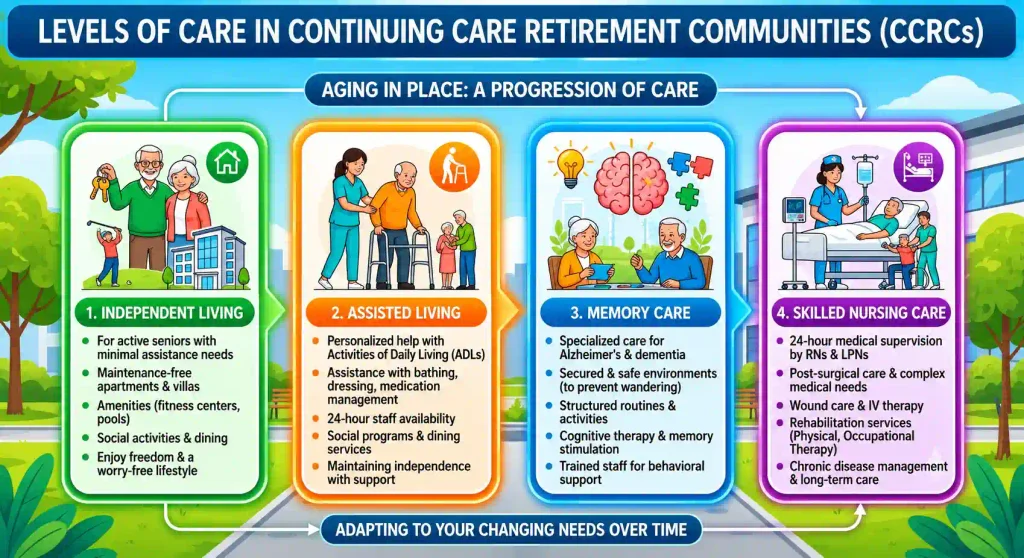
The specific services vary by community, but many CCRCs offer several levels of senior living.
Independent Living
Independent living is generally intended for older adults who can manage their daily routines without regular personal care assistance. Residents may live in private apartments, cottages, or other residential accommodations.
Common features include:
- Dining options and social activities
- Housekeeping and maintenance
- Scheduled transportation
- Recreational and wellness programs
Assisted Living
Assisted living provides additional support for residents who need help with everyday activities, such as bathing, dressing, grooming, or medication management. The level of assistance depends on individual needs and the services offered. Understanding how senior care needs are assessed can help families compare the level of support available.
Memory Care
Some CCRCs offer specialized memory care for residents living with Alzheimer’s disease or other forms of dementia. These settings may provide structured routines, supervision, and specialized support for people living with dementia.
Skilled Nursing Care
Skilled nursing provides a higher level of healthcare support for people who need ongoing nursing services, rehabilitation, or assistance with more complex medical needs.
Important: Not every CCRC includes memory care or skilled nursing on-site. Ask whether these services are operated by the community, provided through an affiliated organization, or arranged externally.
How Does a Continuing Care Retirement Community Work?
A CCRC generally allows residents to enter the community while they are relatively independent and access additional care as their circumstances change.
For example, an older adult may initially move into an independent living apartment. Several years later, they may need assistance with bathing and dressing. If the community offers assisted living and the resident meets its admission requirements, they may transition to that setting.
If their needs eventually require skilled nursing, the CCRC may provide access to nursing services under the terms of the continuing care agreement.
This is an example of continuing care: a resident receives access to different levels of housing and support as their needs change over time.
However, the availability of future care depends on the contract, eligibility requirements, service capacity, and community policies. A CCRC arrangement does not automatically guarantee immediate placement in every care setting.
What Is the Difference Between a CCRC and Other Senior Living Options?
Understanding the differences between senior living arrangements can help families identify which option fits their current and future needs.
| Senior living option | Primary purpose |
| Independent Living | Independent lifestyle with residential services and amenities |
| Assisted Living | Personal care assistance and daily living support |
| Memory Care | Specialized support for residents with dementia |
| Nursing Home | Skilled nursing and higher-level healthcare services |
| Residential Care Home | Smaller residential setting with personal care and supervision |
| CCRC | Housing with access to multiple levels of care through a continuing care arrangement |
The main distinction is that a CCRC combines housing with planned access to additional care services. A standalone assisted living or residential care community may not provide the same range of future care options.
What Are the Different Types of CCRC Contracts?
CCRC contracts explain which services residents receive, what they pay, and how future care expenses are handled. Common contract models include:
- Type A – Life Care Contract: Generally provides a broader range of future healthcare services with limited increases in monthly fees specifically related to a resident’s changing care needs. Other contractual fee adjustments may still apply.
- Type B – Modified Contract: Includes specified healthcare services or a limited amount of higher-level care. Residents may pay additional charges if their needs exceed the coverage included in the agreement.
- Type C – Fee-for-Service Contract: Residents generally pay separately for additional healthcare services when they need them. Monthly housing fees and future care expenses are handled according to the contract.
These labels describe common CCRC contract models. Families should not assume that every Texas provider uses identical terms or coverage arrangements. Review the actual agreement to understand the services, fees, and financial responsibilities involved.
CCRC contract structures are different from Texas assisted living facility classifications. Understanding the Texas Type A and Type B distinctions can help clarify the difference between these two systems.
How Much Does a Continuing Care Retirement Community Cost?
CCRC expenses generally include an initial entrance fee and recurring monthly charges. The total cost depends on the community, accommodation, contract type, and services included.
Before choosing a community, families should understand:
- Entrance fees: The initial payment required to enter a continuing care arrangement.
- Monthly fees: Recurring charges for housing, meals, amenities, and included services.
- Additional care costs: Expenses for services not covered by the basic agreement.
- Refund policies: Whether some or all of the entrance fee is refundable and under what conditions.
- Fee adjustments: How monthly charges may increase over time.
Texas law requires continuing care disclosure statements to explain services, fees, cancellation conditions, entrance fee refund provisions, and recurring fee adjustments. Families should review these details before making a financial commitment.
What Are the Benefits and Disadvantages of a CCRC?
A CCRC can offer several advantages, but it is not automatically the right choice for every older adult.
Potential benefits include:
- Access to multiple levels of senior living.
- Opportunities to remain within a familiar community as needs change.
- Social activities and shared amenities.
- Long-term housing and care planning.
- Less need to independently search for another provider when additional support becomes necessary.
Potential disadvantages include:
- High initial entrance fees.
- Ongoing monthly expenses.
- Complex contractual and financial arrangements.
- Possible additional charges for certain care services.
- Limited flexibility after making a long-term commitment.
- No automatic guarantee of immediate access to every care level.
Another important consideration is the financial stability of the provider. Families should review available financial disclosures and understand how the community plans to meet its long-term contractual obligations.
What Is the Best Age to Move to a CCRC?
There is no universally best age to move into a Continuing Care Retirement Community. The right time depends on a person’s health, financial readiness, lifestyle preferences, and the community’s admission requirements.
Some older adults consider moving while they are still independent because they have more opportunities to become familiar with the community and understand its services. Waiting until significant care needs develop may limit available choices because some CCRCs require residents to meet specific health and independence criteria at admission.
Families should consider future planning rather than relying on age alone.
What Should Texas Families Check Before Choosing a CCRC?
Before signing a continuing care agreement, families should carefully evaluate the community and its financial arrangements.
Consider these questions:
- Is the provider authorized by the Texas Department of Insurance to offer continuing care contracts?
- What levels of care are available on-site?
- Does the agreement guarantee access to future care or only provide priority access?
- What is included in the entrance fee and monthly charges?
- Under what circumstances can the entrance fee be refunded?
- How are future care costs calculated?
- What happens if the community cannot meet a resident’s changing needs?
- Can spouses remain in the same community if they require different levels of care?
The Texas Department of Insurance provides information about continuing care providers and consumer protections. Families can review the Texas CCRC licensing and consumer protection requirements and check provider status before making a decision.
It is also sensible to have an attorney or qualified financial professional review the agreement before signing.
Frequently Asked Questions About Continuing Care Retirement Communities
What Is the Best Continuing Care Retirement Community?
There is no single best CCRC for every senior. The right community depends on location, available care services, contract terms, financial stability, amenities, and individual preferences. Families should compare several providers and review their disclosure statements before choosing.
What Are the Disadvantages of a Retirement Village?
Retirement villages can involve ongoing fees, additional service charges, limited healthcare availability, and restrictions on housing or community arrangements. However, a retirement village is a broader term and is not necessarily the same as a CCRC. Families should understand the services and contractual commitments associated with each option.
Does Medicare Pay for Continuing Care Retirement Communities?
Medicare generally does not pay for CCRC housing, entrance fees, or routine assisted living expenses. However, eligible residents may receive coverage for certain medically necessary healthcare services, including qualifying short-term skilled nursing care, subject to Medicare requirements.
Are CCRC and Life Plan Communities the Same?
Yes. Life Plan Community is another commonly used name for a Continuing Care Retirement Community. Both terms generally describe communities that combine independent housing with access to additional levels of care.
Exploring Senior Living Options in North Texas
A Continuing Care Retirement Community may suit older adults who want to plan for different levels of care within a coordinated residential arrangement. However, the financial commitment, contract requirements, and available services may not fit every family’s circumstances.
Some seniors may find that independent living, assisted living, memory care, or a residential care home better matches their current needs and preferences.
New Day Lifestyle for Seniors helps families across North Texas understand their senior living options and compare communities based on individual care needs, preferences, and circumstances. Families can receive free, no-obligation guidance when exploring suitable senior living arrangements.
Contact us to discuss your family’s needs and identify senior living options worth considering.