
If you are touring assisted living communities in Texas, you may notice that some are licensed as Type A and others as Type B. The label can look like paperwork, but it matters. In Texas, the license type tells you which residents a community is allowed to serve, especially at night and during an emergency.
Choosing a community with the wrong license can mean a move that does not last. If a loved one’s needs go beyond what a Type A community is licensed for, the family may be asked to find a new home within months. This guide explains the difference between Type A and Type B assisted living in Texas, who each one is for, and the questions to ask before you sign anything.
Type A vs Type B Assisted Living in Texas: The Short Answer
Texas licenses assisted living facilities according to how well residents can leave the building in an emergency and how much help they need at night:
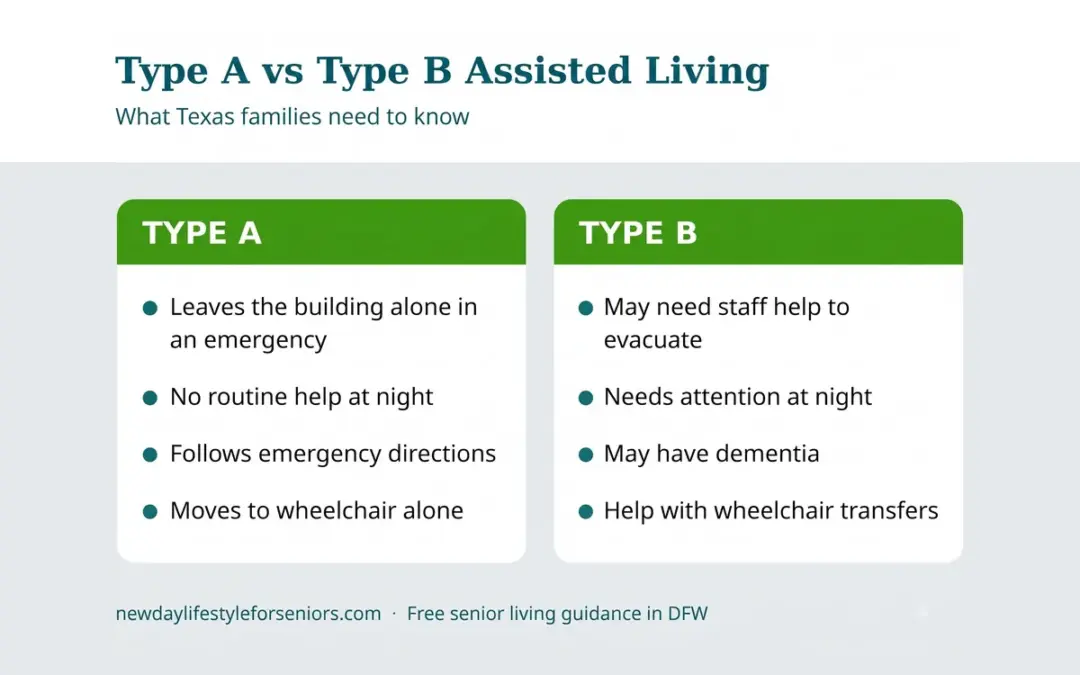
- Type A is for residents who can evacuate without physical help from staff, do not need routine attention during nighttime sleeping hours, and can follow directions in an emergency.
- Type B is for residents who may need staff help to evacuate, need attention during nighttime sleeping hours, may not be able to follow directions in an emergency, and may need help transferring to and from a wheelchair.
These definitions come from the Texas licensing rules for assisted living facilities, which are enforced by the Texas Health and Human Services Commission (HHSC). HHSC no longer issues the older Type C license, so families today will only see Type A and Type B.
What Is a Type A Assisted Living Facility?
A Type A community serves seniors who are fairly independent but want help with daily tasks such as medication reminders, meals, housekeeping, or bathing. Under Texas rules, Type A residents must be able to:
- Leave the building in an emergency without physical help from staff
- Sleep through the night without needing routine attention from staff
- Understand and follow directions during an emergency such as a fire
Using a wheelchair or a scooter does not automatically rule someone out. A resident who can move from bed to wheelchair and leave the building on their own can still be a good fit for Type A.
Who Type A Is a Good Fit For
- Seniors who are mostly independent but are lonely, skipping meals, or struggling with housework
- Older adults who need help managing medications
- People who walk with a cane or walker, or use a wheelchair independently
- Seniors with no significant memory loss who can respond safely to an alarm
What Is a Type B Assisted Living Facility?
A Type B community is licensed to care for residents with greater physical or cognitive needs. Type B residents may:
- Need staff to help them evacuate the building in an emergency
- Need attention from staff during nighttime sleeping hours
- Be unable to follow directions in an emergency, often because of dementia
- Need help transferring to and from a wheelchair
Type B residents must not be permanently bedfast. A senior who is confined to bed or needs ongoing skilled medical care is usually better served by a nursing home. Our guide to assisted living vs. nursing homes explains where that line usually falls.
Who Type B Is a Good Fit For
- Seniors who wander, get up confused at night, or need help to the bathroom at night
- Residents who need one-person help to stand or move to a wheelchair
- People with Alzheimer’s or other dementia who could not respond safely to a fire alarm
- Families who want a community that can keep a loved one longer as needs increase
Type A vs Type B: Side-by-Side Comparison
| Question | Type A | Type B |
|---|---|---|
| Can the resident leave the building alone in an emergency? | Yes, without physical help from staff | May need staff help |
| Does the resident need attention at night? | No routine nighttime attention | Yes, may need attention during sleeping hours |
| Can the resident follow emergency directions? | Yes | May not be able to |
| Help moving to and from a wheelchair? | Should transfer independently | Help is allowed |
| Typical resident | Mostly independent, needs some daily help | Higher physical needs or memory loss |
| Can serve residents with dementia? | Early-stage only, if they can evacuate safely | Yes, including many memory care communities |
Where Does Memory Care Fit In?
Many families assume memory care is its own license type. In Texas, memory care is usually provided by a Type B community, because residents with moderate or advanced dementia often cannot follow directions in an emergency or need help at night.
Texas also has a separate Alzheimer’s certification for assisted living facilities that offer specialized dementia care. When you tour a community that calls itself memory care, ask whether it holds this certification and what it means for staff training and building safety. You can learn more on our memory care page or compare local options for memory care in McKinney, TX.
Is Type B More Expensive Than Type A?
Often, yes. Type B communities usually need more staff, including awake staff overnight, and that cost tends to show up in the monthly rate or in higher care-level fees. A Type A community can be the better value when a loved one is still independent.
Price depends on far more than the license, though: location, apartment size, and the community’s care-level pricing all play a part. For current local numbers, see our Texas assisted living pricing guide.
How to Tell Which License Type Is Right for Your Loved One
Ask yourself these questions, ideally with input from your loved one’s doctor:
- If the fire alarm went off at 2 a.m., could Mom or Dad get up and walk out without help? If not, look at Type B.
- Do they wake up confused, wander, or need help to the bathroom at night? That points to Type B.
- Can they move from bed to chair or wheelchair on their own? If they need hands-on help, Type B is usually required.
- Is memory loss getting worse? Even if Type A works today, a Type B community may avoid a second move later.
Most communities do their own assessment before move-in. Our article on the levels of care assessment explains what to expect.
Questions to Ask on a Tour
- Is this community licensed as Type A or Type B? Can I see the license?
- How many staff are awake and on site overnight?
- What happens if my loved one’s needs change and they no longer fit this license?
- Do you hold Alzheimer’s certification?
- How are care levels priced, and how often are residents reassessed?
- Have there been any recent state inspection violations?
Staffing is one of the clearest signs of quality, so it is worth asking directly. Our guide to staff-to-resident ratios in assisted living shows what to look for.
How to Check a Texas Facility’s License and Inspection History
Before you choose a community, look up its license and inspection history. HHSC publishes a directory of licensed assisted living facilities and assisted living violations data on its assisted living provider page, linked above. Check that the license type matches what the community told you, and ask about anything in the violation records that worries you.
If you have concerns about care after a move, our guide on warning signs and how to report a complaint explains your options.
Common Mistakes Families Make
- Choosing Type A for a parent with worsening dementia. It may work for a few months, but a second move is hard on someone with memory loss.
- Assuming every community offers the same level of care. Two communities on the same street can hold different licenses.
- Comparing base rent only. Care-level fees often make the bigger difference in the monthly bill.
- Skipping the night-time question. Nighttime needs are one of the clearest signs of which license fits.
Frequently Asked Questions
What is the main difference between Type A and Type B assisted living in Texas?
Type A residents can evacuate without staff help, follow emergency directions, and do not need routine attention at night. Type B residents may need help evacuating, need nighttime attention, or may not be able to follow emergency directions.
Can someone in a wheelchair live in a Type A facility?
Yes, if they can transfer and evacuate on their own. A resident who needs staff help to move to and from a wheelchair usually needs a Type B community.
Can a person with dementia live in Type A assisted living?
Someone with early-stage memory loss may be able to live in Type A if they can still follow directions and evacuate safely. As dementia progresses, a Type B or certified memory care community is usually more appropriate.
Does Texas still have Type C assisted living?
No. HHSC no longer issues Type C licenses. Today’s assisted living facilities in Texas are licensed as Type A or Type B.
Who decides whether my loved one needs Type A or Type B?
The community assesses each resident before move-in and when needs change, based on Texas licensing rules. Input from your loved one’s doctor helps make that assessment accurate.
Get Free Help Finding the Right Assisted Living Community
Sorting out license types, care levels, and pricing on your own takes time most families do not have. At New Day Lifestyle for Seniors, our local advisors know which communities in McKinney, Plano, Frisco, Allen, and across the Dallas–Fort Worth area are licensed as Type A or Type B, and which ones fit your loved one’s needs and budget. Our help is free for families.
Browse assisted living communities in McKinney, TX, learn more about assisted living, or call us at (469) 247-9811 or contact our team for a free consultation.