
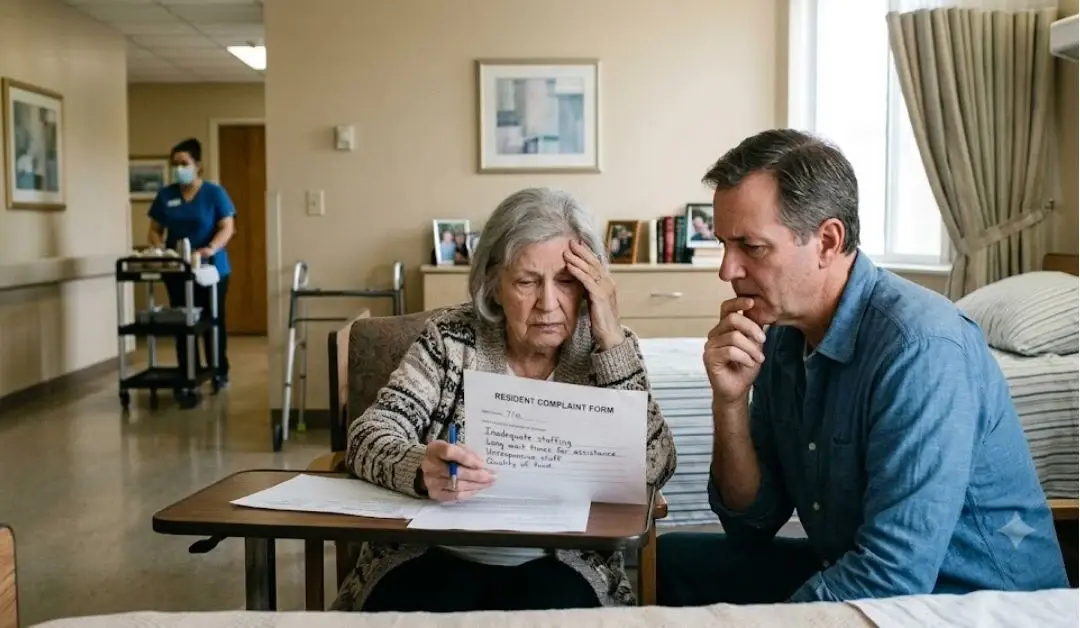
If you’re worried about how a nursing home resident is being cared for, you have three main options: raise it with the facility, file a complaint with your state’s State Survey Agency, or contact your local Long-Term Care Ombudsman. Which one you start with depends on how serious the concern is a scheduling frustration is different from a suspected injury, and a suspected injury is different from a resident in immediate danger.
This guide is written for adult children, spouses, caregivers, and residents themselves who are trying to figure out what to do next. It is not a substitute for legal or medical advice, and reporting procedures do vary by state, we’ll point you to the official agencies that can walk you through your state’s specific process.
Some things families should not brush off, even if they seem small in isolation:
- Unexplained injuries, bruises, cuts, fractures
- Medication problems, missed doses, wrong medications, unexplained sedation
- Poor hygiene, dirty clothing, unwashed hair, uncut nails
- Dehydration or malnutrition, sudden weight loss, refusal of food, untouched trays
- Unsafe conditions, broken equipment, fall hazards, unsanitary rooms
- Unanswered call lights
- Sudden behavioral changes, fear, withdrawal, anxiety around specific staff
- Unexplained financial issues, missing money, unexpected withdrawals
- Repeated communication failures from staff or administration
- Any signs that point toward possible abuse or neglect
One concerning observation doesn’t automatically mean abuse or neglect occurred, people fall, medications get adjusted, moods shift for medical reasons. But a pattern, or anything serious, is worth documenting and, in many cases, reporting to someone outside the facility.
What Counts as a Nursing Home Complaint?
A nursing home complaint is a formal report that a resident isn’t receiving the care, safety, or treatment they’re entitled to under federal and state nursing home regulations. It doesn’t have to involve abuse to be valid, most complaints filed with State Survey Agencies involve quality-of-care or safety issues rather than intentional harm.
Complaints commonly cover:
- Quality of care
- Resident safety
- Staffing levels
- Medication errors
- Poor hygiene
- Nutrition and hydration problems
- Unsafe or unsanitary conditions
- Abuse
- Neglect
- Mistreatment
- Improper or unsafe discharge
- Violations of resident rights
- Failure to follow the resident’s care plan
- Breakdowns in communication with the family
Anyone with relevant knowledge can file a complaint, that includes the resident, a family member, a friend, a visitor, or a staff member, not just a legal guardian. Medicare.gov specifically lists abuse of a resident, insufficient staffing, unsafe or unsanitary conditions, and other forms of mistreatment as examples of nursing home care or facility-condition complaints that should be filed with the State Survey Agency.
Warning Signs of Nursing Home Abuse or Neglect
Warning signs generally fall into five categories: physical, behavioral, medication-related, nutrition/hydration-related, environmental, and financial. No single sign proves abuse or neglect on its own, what matters is whether something is unexplained, repeated, or not adequately addressed when you ask about it.
Physical Warning Signs
- Unexplained bruises, especially in clusters or unusual locations
- Burns
- Bedsores or pressure injuries
- Repeated falls
- Untreated injuries
- Sudden or unexplained weight loss
- Signs of dehydration
- Poor hygiene the resident can’t explain or correct themselves
A single bruise on someone who takes blood thinners or has poor balance isn’t automatically a red flag. A pattern of unexplained injuries, or injuries the facility can’t or won’t explain, is.
Behavioral Warning Signs
- Visible fear or tension around a specific staff member
- Sudden withdrawal from activities or people they used to enjoy
- New anxiety or depression
- Unusual agitation
- Noticeable changes in how they communicate
- Reluctance to speak freely when staff are nearby
Behavioral changes can stem from many causes, a new medication, an illness, cognitive decline, grief. The point isn’t to jump to conclusions; it’s to pay attention and ask direct questions when something feels off.
Medication Warning Signs
- Missed doses
- Medications given incorrectly
- Unexplained sedation or grogginess
- Repeated discrepancies between what’s prescribed and what’s administered
- Sudden, unexplained changes to a treatment plan
If you notice any of these, request a direct explanation from the nursing staff or physician and write down what you’re told, including the date and who you spoke with.
Nutrition and Hydration Warning Signs
- Sudden weight loss
- Signs of dehydration
- Meals that consistently go untouched
- Dietary restrictions that aren’t being followed
- Difficulty physically accessing food or fluids, particularly for residents who need help eating or drinking
Environmental Warning Signs
- Unsanitary rooms or shared spaces
- Persistent odors
- Unsafe or poorly maintained bathrooms
- Rooms that are consistently too hot or too cold
- Broken call buttons, beds, or mobility equipment
- Fall hazards, cords, clutter, wet floors
- Signs of inadequate supervision, especially for residents at fall or wandering risk
Financial Exploitation Warning Signs
- Money or belongings that go missing
- Unexplained withdrawals from the resident’s accounts
- Purchases the resident didn’t make or doesn’t remember authorizing
- Pressure on the resident to sign, change, or update financial documents
Suspected financial exploitation may need to be reported to a different authority than a care complaint, often Adult Protective Services or law enforcement, depending on your state and the specifics of the situation.
What Should You Do If You Suspect Nursing Home Abuse or Neglect?
Start with safety, then documentation, then reporting through the right channel. The sequence below is a general framework, the right first step depends on how urgent the situation is.
- Protect immediate safety. If a resident is in danger right now, safety comes before paperwork.
- Call 911 if it’s an emergency, active harm, a serious injury, or an immediate threat.
- Document what you observed, dates, times, descriptions, and anyone else who saw it.
- Speak with appropriate facility leadership, such as the Director of Nursing or Administrator, when the situation isn’t an emergency.
- Request relevant care-plan or incident information when appropriate, so you have an accurate record of what the facility says happened.
- Contact the State Survey Agency for regulatory and quality-of-care concerns.
- Contact the Long-Term Care Ombudsman for advocacy and help resolving the issue.
- Consider Adult Protective Services or law enforcement when abuse, neglect, or exploitation is suspected.
- Follow up and keep records of every call, email, and response.
Avoid confronting a staff member you suspect of causing harm directly and alone, it can put the resident at greater risk and may compromise a later investigation. Reporting through the facility’s leadership or an outside agency is the safer path.
How to File a Nursing Home Complaint
The general process in the US involves documenting what happened, deciding whether to raise it with the facility first, and then contacting your state’s regulatory agency, the Ombudsman program, or both. The exact steps and contact points vary by state, since nursing home oversight is run at the state level even though it follows federal standards.
Step 1: Write Down the Facts
Before contacting anyone, get the basic facts down while they’re fresh:
- Date and time
- Location within the facility
- What happened, described factually
- Who was involved
- What you personally observed
- Any witnesses
- How staff responded at the time
- The resident’s condition afterward
- Any supporting documentation, photos, medical records, messages
Step 2: Raise the Concern With the Facility
This step can make sense for care-plan questions, communication problems, or issues that seem like an oversight rather than a pattern. People to speak with typically include:
- Director of Nursing
- Administrator
- Social worker
- Charge nurse
- The resident’s care-plan team
Families are not required to rely only on the facility’s internal complaint process, especially when a serious safety or abuse concern is involved. If something feels urgent or the facility is unresponsive, you can go directly to the State Survey Agency or Ombudsman.
Step 3: Contact the State Survey Agency
Each state has a State Survey Agency, usually housed within the state health department, with regulatory responsibility for licensing and inspecting nursing homes, including investigating complaints about care and safety. Medicare’s official complaint guidance confirms that concerns about nursing home care or facility conditions, including abuse of a resident, insufficient staffing, unsafe or unsanitary conditions, or other mistreatment, should be filed with your State Survey Agency.
Contact information is different in every state, so there’s no single national nursing-home complaint number to call. CMS maintains an official directory of State Survey Agency contacts, use that directory rather than a number found on a third-party site, since those can go stale.
Step 4: Contact the Long-Term Care Ombudsman
Every state has a Long-Term Care Ombudsman program, staffed by advocates who work on behalf of residents to resolve complaints about their health, safety, welfare, and rights. Ombudsmen aren’t regulators, they focus on advocacy, communication, and resolution, often working directly with the facility on a resident’s behalf.
Step 5: Contact Other Authorities When Appropriate
Depending on what’s involved, other agencies may need to be part of the picture:
- Adult Protective Services (APS) : Suspected abuse, neglect, or financial exploitation of a vulnerable adult
- Law enforcement : Assault, theft, or any criminal conduct
- State licensing/regulatory authorities : Facility licensing issues outside the survey process
- Medicare-related complaint channels : Quality-of-care concerns tied to a Medicare-covered stay
- Medicaid authorities : Billing or coverage-related concerns where Medicaid is the payer
Each of these plays a different role, and more than one may apply to the same situation.
When Should You Call 911 Instead of Filing a Routine Complaint?
Call 911 when there’s an immediate threat to life or safety, don’t wait for a routine complaint process to catch up with an emergency. A complaint investigation, even a fast one, isn’t built for situations that need an immediate response.
Call 911 for situations like:
- Immediate physical danger to a resident
- A serious injury
- An active assault
- A medical emergency
- Any immediate threat of harm
If you’re not sure whether something is an emergency, treat it as one and let 911 dispatchers help you assess it, that’s safer than waiting on a complaint hotline that isn’t designed to respond in real time.
What Information Should You Include in a Nursing Home Complaint?
A useful complaint gives the reviewing agency enough factual detail to investigate, vague reports are harder to act on. Include what you have, but don’t hold off filing just because a few items are missing.
Complaint checklist:
- Resident’s name
- Facility name
- Facility address
- Date and time of the concern
- Description of what happened
- Staff involved, if known
- Any witnesses
- Medical or care details relevant to the complaint
- Photos or documents, where appropriate
- Whether you’ve raised this concern before
- How the facility responded, if you already raised it
- Your contact information for follow-up
Detailed, factual information helps the agency assign the right level of urgency and gives investigators something concrete to check against the facility’s records.
What Happens After You File a Nursing Home Complaint?
What happens next depends on your state and the type of complaint, there’s no single nationwide process, and no fixed timeline that applies to every case. In general, complaints go through some version of intake, review, and follow-up, but the pace and depth vary by agency and by how serious the concern appears.
Steps that commonly occur, in some order:
- Complaint intake and logging
- Initial review or triage to assess urgency
- Contact from the agency for more information
- Records review
- Interviews with staff, residents, or family
- A facility investigation
- An on-site investigation, when warranted
- Findings communicated back, and any required follow-up with the facility
CMS’s own guidance on reporting and resolving nursing home problems walks through the steps involved in filing a quality-of-care complaint, but it doesn’t promise a specific outcome or timeline. Not every complaint results in a full on-site investigation, and not every finding becomes public in the same way, how information is shared back with the person who filed the complaint also varies by state.
State Survey Agency vs. Long-Term Care Ombudsman
These two resources overlap in purpose but play different roles, one regulates, the other advocates.
| Resource | Main Role | Best Used For |
|---|---|---|
| State Survey Agency | Regulatory oversight and investigation | Regulatory violations and quality-of-care complaints |
| Long-Term Care Ombudsman | Resident advocacy and complaint resolution | Resident rights, care concerns, communication and advocacy |
| Adult Protective Services | Protection from abuse, neglect, or exploitation | Suspected abuse, neglect, or financial exploitation, where applicable |
| Law Enforcement | Criminal and public safety matters | Assault, theft, immediate danger, criminal conduct |
| 911 | Emergency response | Immediate threat to life or safety |
Exact jurisdiction, intake processes, and reporting requirements vary by state, when in doubt, it’s reasonable to contact more than one of these resources for the same concern.
How to Find Your State’s Nursing Home Complaint Agency
Your state’s specific contact information for filing a nursing home complaint comes from CMS’s official State Survey Agency directory, since every state runs its own agency and process. There isn’t one national hotline that covers every state, CMS keeps a state-by-state list precisely because the contact points differ.
Find your state’s nursing home complaint contact through CMS’s official State Survey Agency directory.
Avoid relying on an old phone number pulled from a third-party website, go to the CMS source directly and confirm current contact information for your state.
How Does the Long-Term Care Ombudsman Help?
The Long-Term Care Ombudsman program advocates for residents’ rights and works to resolve complaints related to their health, safety, welfare, and rights, it isn’t a regulatory body and doesn’t determine on its own whether abuse legally occurred. ACL’s Long-Term Care Ombudsman Program page describes advocates who work to resolve problems and advocate for residents’ rights, health, safety, and welfare.
Ombudsman representatives commonly help with:
- Advocating for the resident directly with facility staff
- Working to resolve complaints about care
- Educating residents and families about their rights
- Supporting communication between residents, families, and the facility
- Concerns about discharge or eviction
- Abuse- or neglect-related concerns, within the scope of the program’s advocacy role
Their role is different from a regulatory investigation or a law-enforcement inquiry, Ombudsmen work toward resolution and advocacy, while State Survey Agencies and law enforcement have the authority to investigate and enforce compliance.
How to Document Nursing Home Problems
Good documentation is one of the most practical things a family can control, and it strengthens whatever complaint you eventually file. Build the habit before you think you’ll need it.
- Keep a dated incident log, even for small concerns
- Save emails and written communication with the facility
- Keep copies of any complaint submissions
- Record names and job titles of staff you speak with
- Keep relevant medical records
- Photograph conditions when appropriate and lawful
- Track follow-up dates so nothing falls through the cracks
- Write down exactly what the facility promised to do, and by when
Stick to what you observed and what you were told, factual documentation holds up better than assumptions or interpretations, both with the facility and with any agency reviewing your complaint.
Nursing Home Complaint Template
Use this as a starting structure for a written complaint to a facility, State Survey Agency, or Ombudsman office. Keep it factual and non-accusatory, describe what happened rather than characterizing intent.
Subject: Formal Concern Regarding Resident Care at [Facility Name]

Resident: [Name]
Facility: [Name]
Date(s) of concern: [Date(s)]

Description of concern:
[What happened, in plain, factual language]

What I observed:
[Specific details — what you saw, heard, or were told]

Who I notified:
[Names, titles, dates of any conversations with facility staff]

Facility response:
[What, if anything, the facility said or did in response]

Supporting documentation:
[Photos, records, messages — list what you have]

Requested follow-up:
[What you're asking the recipient to do]

Contact information:
[Your name, phone, and email for follow-up]
How to Check a Nursing Home Before Choosing It
Complaint history is one piece of a much larger quality picture, reviewing it alongside inspection and staffing data gives a fuller sense of a facility before move-in. Families comparing options can look at:
- Medicare Care Compare for official ratings
- Health inspection results
- Staffing levels and nurse-to-resident ratios
- Quality measures
- Facility ownership information, where publicly available
- In-person conditions during a tour
- Feedback from current residents and families, used as supplementary context rather than a primary factor
If you’re researching options from the ground up, not just responding to a concern at a facility you’ve already chosen, our complete nursing home guide covers care levels, costs, and how to evaluate a facility in detail. It also walks through the difference between the CMS 5-star rating system and what a facility’s day-to-day conditions actually look like on a tour.
Nursing Home Complaints vs. Nursing Home Ratings
A complaint and a star rating measure different things, a facility’s quality rating isn’t recalculated every time a single complaint is filed. CMS Care Compare ratings are built from health inspections, staffing data, and quality measures gathered over time, while complaint investigations respond to specific reported concerns. A single complaint doesn’t automatically change a facility’s overall rating, though patterns of substantiated complaints can factor into inspection outcomes over time. For a deeper look at how the star system is built and what it actually reflects, see our guide on reading CMS 5-star nursing home ratings.
What If the Nursing Home Retaliates After a Complaint?
Document anything that looks like retaliation and route it through the same channels you’d use for any other serious concern, the Ombudsman and, where applicable, the State Survey Agency. Retaliation might look like a sudden change in the resident’s treatment, new restrictions on visits, or pressure directed at the resident or family after a complaint is filed.
Steps to take:
- Document what changed and when, in relation to the complaint
- Keep copies of all related communications
- Contact the Long-Term Care Ombudsman
- Contact the State Survey Agency where the concern involves care or regulatory compliance
- Seek legal advice if the situation raises a legal rights question, protections and remedies can differ by state, and an attorney familiar with your state’s elder law is better positioned to advise on that than a general guide like this one
Can Family Members File a Nursing Home Complaint?
Yes. Medicare.gov’s complaint guidance treats nursing home care or facility-condition complaints, including abuse, insufficient staffing, and unsafe or unsanitary conditions, as something to report to the State Survey Agency, and this channel is open to residents, family members, representatives, and anyone else with direct knowledge of a concern, not only a legal guardian. You don’t need to be the resident’s power of attorney to file a report.
Common Mistakes Families Make When Reporting Nursing Home Problems
- Waiting too long, hoping the issue resolves on its own
- Relying only on verbal conversations with staff, with nothing written down
- Failing to record specific dates and times
- Leading with emotional accusations instead of factual descriptions
- Not escalating when a concern raised with the facility goes unresolved
- Contacting the wrong agency, or not knowing which one applies
- Overlooking the resident’s own consent and privacy preferences
- Treating online reviews as a substitute for official inspection and complaint data
- Treating a genuine emergency like a routine complaint, or the reverse
Nursing Home Complaint Checklist
- Document the concern
- Record date and time
- Identify everyone involved
- Photograph or document evidence where appropriate
- Notify appropriate facility staff
- Keep written records of every conversation
- Contact the State Survey Agency, if appropriate
- Contact the Long-Term Care Ombudsman
- Contact Adult Protective Services or law enforcement, when appropriate
- Follow up on your complaint
- Keep copies of everything you submit
Frequently Asked Questions
How do I file a nursing home complaint?
Document what happened, then contact your state’s State Survey Agency and/or your local Long-Term Care Ombudsman. For an emergency, call 911 first. Exact intake steps vary by state, so it’s worth checking your state’s specific process through the official CMS directory.
Who investigates nursing home complaints?
State Survey Agencies investigate complaints related to quality of care and regulatory compliance. The Long-Term Care Ombudsman focuses on advocacy and resolution rather than formal regulatory investigation, and Adult Protective Services or law enforcement may get involved when abuse, neglect, or a crime is suspected.
Can a family member file a nursing home complaint?
Yes. Family members, resident representatives, and anyone with relevant knowledge of a concern can file a complaint, you don’t need to be the resident’s legal guardian.
How do I report nursing home abuse?
Call 911 for an immediate emergency. Otherwise, document what you observed and report it to the State Survey Agency, the Long-Term Care Ombudsman, and, where abuse or exploitation is suspected, Adult Protective Services.
What is the difference between a State Survey Agency and an Ombudsman?
The State Survey Agency has regulatory authority to investigate and enforce compliance with nursing home standards. The Ombudsman advocates for residents and works toward resolving complaints, without regulatory enforcement power.
What are common signs of nursing home neglect?
Unexplained weight loss, dehydration, poor hygiene, untreated pressure injuries, unanswered call lights, and missed medications are common signs. A single instance isn’t automatically neglect, patterns and unexplained changes are what warrant closer attention.
What should I document before filing a complaint?
Dates, times, what you observed, who was involved, any witnesses, how staff responded, and any supporting photos or records. The more specific and factual, the more useful it is to the reviewing agency.
What happens after I file a nursing home complaint?
The process varies by state and complaint type, but generally includes intake, review, possible contact from the agency, and, depending on the concern, an investigation. There’s no universal timeline, and not every complaint leads to an on-site visit.
Can I report a nursing home anonymously?
Depending on the state and agency, anonymous reporting may be an option, though providing contact information can make it easier for the agency to follow up or ask clarifying questions. Check with your state’s specific agency for its process.
What should I do if a nursing home resident is in immediate danger?
Call 911 immediately. Don’t wait on a routine complaint process for a situation that needs an emergency response.
If You’re Also Weighing Whether Nursing Home Care Is the Right Setting
If you’re trying to determine whether a nursing home is the right setting for your loved one, or whether another senior care option may be a better fit, New Day Lifestyle for Seniors can help you understand the available options and compare communities. In our experience helping families compare senior care options across McKinney and the DFW Metroplex, questions about care quality and questions about the right level of care often come up in the same conversation, and it helps to look at both together.
If cost is part of what’s driving the conversation, our guide to how much nursing homes cost per month in 2026 and our explainer on what happens to Social Security once Medicaid starts paying for nursing home care cover two of the most common financial questions families have alongside care-quality concerns. You can also reach our senior care advisors directly if you’d like to talk through your family’s specific situation.
New Day Lifestyle for Seniors is a senior living placement and referral resource. We are not a government regulator, law enforcement agency, attorney, or medical provider, and we do not investigate complaints, for that, use the state and federal resources listed throughout this guide.