
By Mimi Tapia-Bowie, Founder, New Day Lifestyle for Seniors (20+ years in senior care) | Last updated: September 2026
A Hoyer lift is a mobile patient lift that uses a sling and a hydraulic or electric mechanism to move a person who cannot safely stand or walk, for example from a bed to a wheelchair, chair, or commode. “Hoyer” is a brand name that people now use for patient lifts in general. Most lifts need two trained caregivers to operate safely.
A Hoyer lift is often the piece of equipment that makes caring for a parent or spouse at home possible again. It protects your loved one from falls during transfers, and it protects you from the back and shoulder injuries that come from lifting another adult by hand.
It can also be intimidating. Between sling types, weight limits, manual versus electric models, and insurance rules, families often feel unsure where to start. This guide explains what a Hoyer lift is, how it works, what it costs, whether Medicare helps pay, how to use one safely, and how to choose the right one.
What Is a Hoyer Lift?
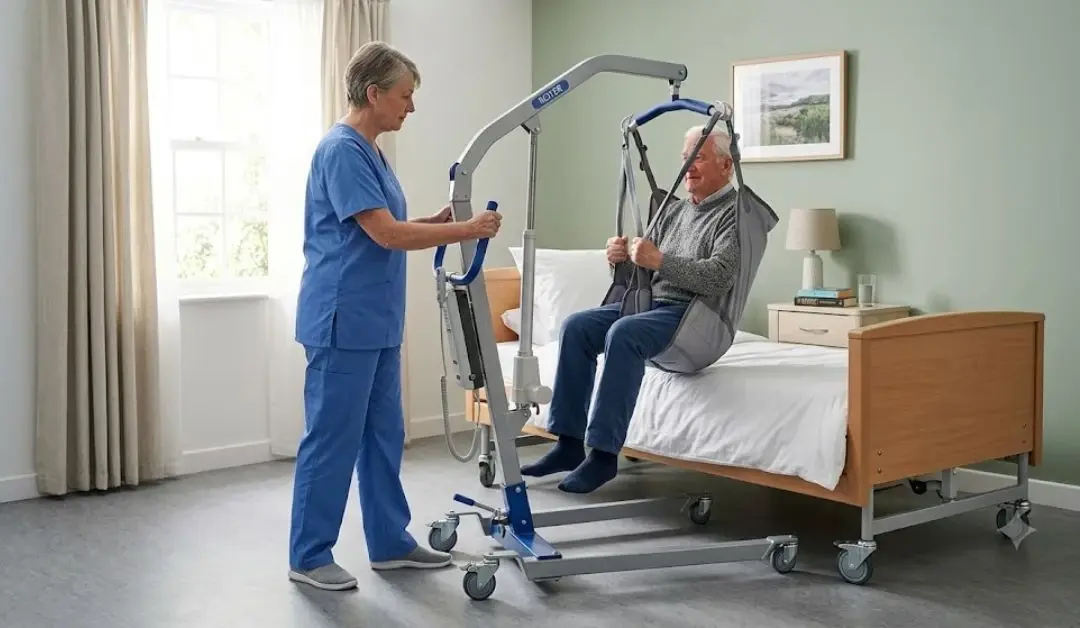
A Hoyer lift is a patient lift: a mobile device with a wheeled base, a vertical mast, a boom arm, and a sling that cradles the person being moved. The caregiver positions the sling, attaches it to the boom, raises the person a short distance, and rolls the lift to the new location. Then the person is lowered onto a bed, wheelchair, chair, or commode.
“Hoyer” started as a brand name, but many people and suppliers now use it for any full-body sling lift. You will also see the same equipment called a patient lift, patient hoist, mechanical lift, or transfer lift. For the purposes of buying or renting one, all of these terms point to similar equipment, so check the specific model, capacity, and sling compatibility rather than the brand name alone.
A Hoyer-style lift is designed for people who:
- Cannot bear enough weight on their legs to stand or pivot safely
- Need more than one person to help them transfer
- Are at high risk of falling during a transfer
- Have a caregiver who is at risk of injury from manual lifting
How Does a Hoyer Lift Work?
Every floor-based sling lift has the same basic parts:
- Base with legs and casters: A wheeled frame that rolls under a bed or around a chair. The legs can usually be opened wider for stability.
- Mast and boom: The upright post and the arm that extends over the person being lifted.
- Lifting mechanism: Either a manual hydraulic pump (the caregiver pumps a handle to raise the boom and releases a valve to lower it) or an electric motor with a hand control and rechargeable battery.
- Spreader bar or hanger: The bar at the end of the boom where the sling attaches.
- Sling: The fabric support that goes around the person’s back and under their thighs. Slings come in different sizes and styles, and they must match the lift.
In practice, the caregiver slides the sling behind the person, attaches the straps to the hanger, raises the person slightly off the surface, guides the lift to the destination, and gently lowers the person. Good technique keeps the person’s arms inside the sling straps, the lift base in a stable position, and the receiving surface locked in place. The full step-by-step is below.
Types of Patient Lifts
Not every lift is a Hoyer-style floor lift. The right type depends on how much the person can help with the transfer, the layout of the home, and who will operate it.
| Lift type | How it works | Best for | Things to consider |
|---|---|---|---|
| Manual hydraulic floor lift (classic Hoyer style) | Caregiver pumps a handle to raise the person in a sling | Home use when a person can’t bear weight and a caregiver is available | Usually the lowest-cost option; needs caregiver strength to pump |
| Electric (powered) floor lift | Battery-powered motor raises and lowers the sling with a hand control | Caregivers who want less physical effort, or frequent transfers | Higher cost; charge the battery regularly |
| Sit-to-stand lift | Person sits or leans on a support, and the lift helps them rise to a standing position | People who can bear some weight and have trunk control | Not suitable if the person cannot bear any weight |
| Ceiling (overhead) lift | Motorized unit on a track attached to the ceiling moves the person in a sling | Long-term care at home with frequent transfers and limited floor space | Needs professional installation; typically the highest cost |
Ask your loved one’s doctor, occupational therapist (OT), or physical therapist (PT) which type fits the person’s strength, balance, and cognitive ability. A home assessment by an OT is the most reliable way to match a lift to your home.
Who Needs a Hoyer Lift?
A lift is usually worth discussing when:
- Your loved one cannot stand or bear weight even with help
- Transfers take two people, or you are the only person available
- There have been falls or near-falls during transfers
- A caregiver has back, shoulder, or wrist pain from lifting
- Your loved one is recovering from a hospital stay or surgery and cannot yet pivot safely
If transfers are becoming the main challenge, it is also a sign to look at the overall level of care your loved one needs. Our guide to how care levels are assessed explains what communities look at, and our list of signs a parent may be ready for assisted living can help you recognize when home care alone may no longer be enough.
From Mimi’s experience: From my experience, families often ask whether a lift can make transfers safer and less stressful for both their loved one and the caregiver. I encourage families to consider a lift when transfers are becoming difficult, especially if there is a risk of falls or the caregiver is struggling with the physical demands.
Hoyer Lift vs Sit-to-Stand Lift
Families often wonder which one they need. The deciding question is whether your loved one can bear some weight on their legs.
| Hoyer-style sling lift | Sit-to-stand lift | |
|---|---|---|
| Person can bear weight? | Not needed | Yes, some weight needed |
| Body support | Full-body sling, person is fully supported | Chest or back support plus a knee pad |
| Good for | Bed-to-chair transfers for people with very limited mobility | Transfers to the toilet or chair for people with some leg strength |
| Typical use | Bed, chair, wheelchair, commode | Bed, toilet, chair |
A healthcare professional can test your loved one’s standing ability. If their condition changes, the right lift may change too.
How to Choose the Right Patient Lift
Use this checklist before you buy or rent:
- Get a professional recommendation. A doctor, OT, or PT can assess strength, balance, and cognition.
- Check the weight capacity of both the lift and the sling. Never exceed either limit.
- Match the sling to the lift. According to the FDA, a sling must be approved for use by the patient lift’s manufacturer, and no sling works with all lifts.
- Measure your space. Check doorway widths, turning room, flooring (thick carpet makes rolling harder), and whether the base can fit under the bed or chair.
- Decide manual vs electric. Electric models reduce physical effort but cost more and need charging. Manual models are simpler but need a caregiver who can pump comfortably.
- Count your caregivers. Most lifts need two trained people. If only one person will be available, discuss safer options with the therapist.
- Ask for training. A good supplier or therapist will show every caregiver how to use the lift before the first real transfer.
- Plan the budget. Compare buying, renting, and what insurance covers (see below).
- Consider the long term. Will a ceiling lift or a change in care setting make more sense if needs increase?
Types of Slings at a Glance
The sling matters as much as the lift. Common styles include:
- Full-body slings that support the back, hips, and thighs, used for most bed-to-chair transfers
- Hygiene or toileting slings with an opening that allows clothing changes and toileting while supported
- Head-support slings for people who need head and neck support
- Mesh or bath slings designed to be used around water
Always follow the lift manufacturer’s sling sizing chart. Inspect slings regularly and stop using any with fraying, tears, or worn seams.
How to Use a Hoyer Lift Safely
Important: This is general education, not a substitute for hands-on training. Always follow the manufacturer’s instructions and the training given by your therapist or supplier.
The FDA publishes best practices for patient lifts. In plain language, the general flow looks like this:
- Get trained first. Everyone who will operate the lift should learn on the exact model being used.
- Inspect the lift and sling. Check the sling fabric and straps for fraying or damage. Confirm the lift moves smoothly and the battery (if electric) is charged.
- Prepare the space. Lock the wheels on the bed, wheelchair, or chair that will receive the person, and clear the path.
- Position the sling correctly under the person, following the sling’s instructions, with the right size chosen.
- Open the base legs fully and position the lift for maximum stability.
- Attach the sling to the hanger, making sure all clips, latches, and hooks are secure, and that the person’s arms are inside the straps.
- Check the person. The FDA advises making sure the person is not restless or agitated before lifting. If they are very anxious or confused, pause and reassure them.
- Lift slowly just high enough to clear the surface, and recheck that the person is secure before moving.
- Move and lower gently, guiding the lift to the new surface. Keep talking to the person so they know what is happening.
- Never leave the person unattended while they are in the lift. After the transfer, detach the sling and move the lift safely out of the way.
The FDA’s patient lift safety guide adds that most lifts need two or more caregivers to operate safely, and it recommends a safety check before the person is lifted. Families caring for someone with dementia should plan extra time and calm, consistent routines, because agitation during a transfer raises risk. Our article on how memory care for dementia helps seniors live safely explains how communities handle these situations.
Common Hoyer lift mistakes to avoid
- Using a sling that was not made for that lift, or the wrong size
- Skipping sling inspections
- Operating the lift alone when two caregivers are required
- Not locking the wheels on the bed or wheelchair
- Exceeding the weight limit of the lift or sling
- Transferring a person who is agitated or uncooperative without help
The FDA notes that patient falls from lifts have caused serious injuries, including head trauma, fractures, and deaths. That is why training and careful setup matter so much.
How Much Does a Hoyer Lift Cost?
Patient lift prices vary widely by type, brand, capacity, and features. Published guides generally describe costs ranging from a few hundred dollars to a few thousand dollars for floor lifts. Electric models, bariatric (higher-capacity) lifts, and ceiling systems with installation usually cost more. Slings are often sold separately, and you may need more than one size or style.
Ways to manage the cost:
- Rent instead of buying if the need is short term, such as after surgery.
- Ask about used or refurbished lifts from a reputable medical equipment supplier, and confirm the lift has been inspected.
- Check community resources. Equipment loan programs are sometimes offered through local organizations, and the Eldercare Locator can connect you with your local Area Agency on Aging.
- Get several quotes. Prices and included accessories differ between suppliers.
Prices change, so confirm current costs directly with suppliers. This guide cannot quote a specific price for your situation.
Does Medicare Cover a Hoyer Lift?
Original Medicare (Part B) may help pay for a patient lift when it is considered durable medical equipment (DME) and your doctor prescribes it for use in your home. Key points, based on Medicare.gov and Medicare coverage guidance:
- A doctor’s order is required, and the lift must be medically necessary for use at home.
- The medical need matters. Medicare’s coverage guidelines describe a patient lift as covered when transfers between a bed and a chair, wheelchair, or commode are required and, without the lift, the person would be bed-confined.
- Use a Medicare-enrolled supplier that accepts assignment. Otherwise, you may pay more.
- You typically pay 20% of the Medicare-approved amount after meeting the Part B deductible ($283 in 2026), unless you have supplemental coverage such as Medigap that helps with coinsurance.
- Patient lifts are often “capped rentals.” Under this rule, if you make rental payments for 13 months, the supplier treats you as the owner.
- Coverage is usually for a standard manual lift. Coverage for electric or ceiling lifts is more limited and can depend on the situation, so ask the supplier and Medicare before you order.
- Medicare Advantage plans must cover at least what Original Medicare does, but details vary by plan, so check your plan’s rules and network.
Medicaid programs, including state home- and community-based programs, may also help with equipment for people who qualify. In Texas, ask your managed care plan or the Texas Health and Human Services Commission what equipment is covered for your loved one.
Because coverage rules are technical and can change, confirm details on Medicare.gov’s patient lift page or by calling 1-800-MEDICARE. Medicare’s general explanation of durable medical equipment coverage is also a helpful starting point. If you are also researching nursing home coverage, see our guide on what Medicare pays for in nursing homes, which explains a different set of benefits.
Hoyer Lifts at Home vs in a Senior Living Community
If your loved one needs a lift for transfers, it is worth asking whether care at home can stay safe over time. Transfers that need two trained people can be hard to sustain for a family caregiver, especially at night.
If you are considering a community, ask directly how they handle residents who need a lift:
- Do they accept residents who need a mechanical lift for transfers?
- How many trained staff members are available, including overnight? Our article on the staff-to-resident ratio in assisted living explains what to ask.
- Who trains the staff, and how often?
- What happens if your loved one’s needs increase?
Policies differ by community, care type, and state licensing rules. Some assisted living communities can support residents who need lift-assisted transfers, while others cannot, and a skilled nursing setting may be more appropriate. Our comparison of assisted living vs nursing homes and our explanation of nursing homes vs residential care facilities can help you understand the differences. If you want to see how a community decides who is a good fit, read who is eligible for assisted living.
If your loved one is staying at home for now, you may also want to add safety tools such as alerts and fall detection. See our guide to senior monitoring systems.
How New Day Lifestyle for Seniors Can Help
When a loved one needs a lift, families are often also facing a bigger question: what level of support will be safe and sustainable? At New Day Lifestyle for Seniors, we help families across McKinney and the Dallas-Fort Worth area compare assisted living, memory care, residential care homes, and nursing homes, and we can ask communities the right questions about lift-assisted transfers, staffing, and cost. Our guidance is free to families.
Talk to a senior care advisor: call 469-247-9811 or contact us
Frequently Asked Questions
1. What is a Hoyer lift used for?
A Hoyer lift is used to move a person who cannot safely stand or walk, such as from a bed to a wheelchair, chair, or commode. It uses a sling and a hydraulic or electric mechanism so caregivers do not have to lift the person by hand.
2. Is “Hoyer lift” the same as a patient lift?
Mostly, yes. “Hoyer” began as a brand name, but people commonly use it to mean any mobile sling-based patient lift. When you shop or rent, look at the model’s type, weight capacity, and sling compatibility.
3. How does a Hoyer lift work?
A sling is placed under the person and attached to a boom on a wheeled base. The caregiver raises the person slightly using a hydraulic pump or electric motor, rolls the lift to the new location, and lowers the person onto the bed, chair, or commode.
4. Can one person use a Hoyer lift?
Many lifts require two trained caregivers for safe use, and the FDA notes that most lifts need two or more. Some models can be operated by one person with proper training, but your therapist or the manufacturer’s instructions should determine whether that is safe for your situation.
5. How much does a Hoyer lift cost?
Floor lifts generally cost from a few hundred to a few thousand dollars depending on type and features. Ceiling lifts and bariatric models usually cost more. Always confirm current prices with suppliers.
6. Does Medicare cover a Hoyer lift?
Original Medicare Part B may cover part of the cost when a doctor prescribes a patient lift as medically necessary for home use and you use a Medicare-enrolled supplier. You usually pay 20% after the Part B deductible. Coverage for electric or ceiling lifts is more limited, so confirm with Medicare and your supplier.
7. What is the difference between a Hoyer lift and a sit-to-stand lift?
A Hoyer-style lift fully supports the person in a sling and works even if they cannot bear weight. A sit-to-stand lift helps a person rise to standing and requires some leg strength and trunk control.
8. How much weight can a Hoyer lift hold?
It depends on the model. Standard lifts have a stated weight limit, and bariatric models are built for higher capacities. Check the lift’s label and the sling’s rating, and never exceed either one.
9. Is a Hoyer lift safe?
When used correctly, patient lifts reduce injury risk for both the person and the caregiver. The FDA warns that improper use can lead to serious falls, so training, correct sling selection, regular inspection, and following the manufacturer’s instructions are essential.
10. When should a family consider moving to a care community instead of using a lift at home?
If transfers need two people and you cannot reliably have two trained caregivers, if nights are unsafe, or if caregiver strain is rising, it is worth exploring communities that provide trained staff. A senior care advisor can help you compare options based on your loved one’s needs.
Sources & References
- FDA: Patient Lifts (safety and best practices)
- FDA: Patient Lifts Safety Guide (PDF)
- Medicare.gov: Patient Lifts
- Medicare.gov: Durable Medical Equipment (DME) Coverage
- CMS Medicare Coverage Database: Patient Lifts LCD L33799
- Eldercare Locator (U.S. Administration for Community Living)
This article is for general education and is not medical advice. A doctor, occupational therapist, or physical therapist should assess your loved one and recommend the right lift and sling. Always follow the manufacturer’s instructions and get hands-on training before using a patient lift.