
If you’ve ever searched for a nursing home for a parent, spouse, or yourself, you’ve probably landed on a page with a row of gold stars next to a facility’s name. That’s the CMS 5-star rating for nursing homes, and while it looks simple, most people misread it completely.
Here’s the part almost nobody explains clearly: the star rating and the state survey results aren’t two separate things you need to research independently. The survey is the biggest ingredient in the star rating. Understanding one means understanding the other. In this guide, we’ll walk through both together, how the rating is built, what’s actually in a state survey report, and how to use them side by side to make a real decision, not just a gut-feel one.
What Is the CMS 5-Star Quality Rating System?
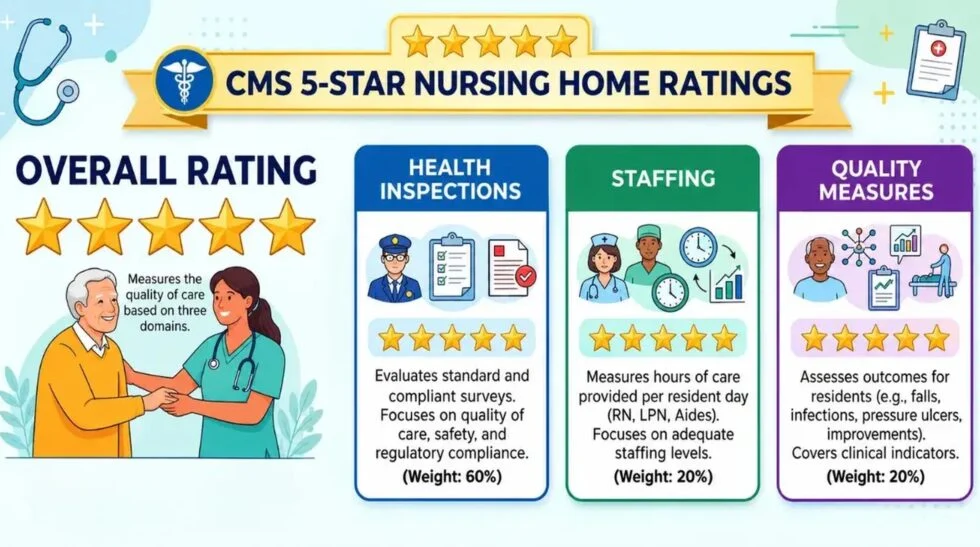
The Centers for Medicare & Medicaid Services (CMS) created the Five-Star Quality Rating System to give families a fast way to compare nursing homes on the Care Compare website. Every Medicare- or Medicaid-certified nursing home gets an overall rating from 1 to 5 stars, plus three separate sub-ratings:
- Health Inspections (60–70% of the overall score) built directly from state survey results
- Staffing (15–20%) nurse staffing hours per resident day, case-mix adjusted
- Quality Measures (15–25%) clinical outcomes pulled from resident assessment data (MDS)
A 5-star facility is considered “much above average,” and a 1-star facility “much below average”, but CMS itself is upfront that the rating can’t capture everything, including specialty care availability or how easy the location is for family visits.
Ratings are refreshed quarterly, and CMS periodically updates the scoring methodology and cut points, so a facility’s star count can shift even if nothing changed on the ground.
A high star rating is only half the picture, though, it’s worth understanding what you’re paying for when comparing facility costs before you shortlist based on stars alone.
Why State Survey Results Are the Real Engine Behind the Rating
This is the piece most articles skip. The Health Inspection score, the single biggest factor in the overall star rating, comes straight from state survey results.
Here’s how it works:
- Every certified nursing home gets an in-person, unannounced inspection by a state survey agency, typically once a year (and after any complaint).
- Surveyors check the facility against federal quality and safety standards, everything from infection control and medication management to resident dignity and staffing adequacy.
- Any problems found are documented as deficiencies, each tagged with a severity and scope level (how serious, and how many residents were affected).
- CMS converts the last three years of survey results, plus complaint investigations, into a numeric score, which becomes the Health Inspection star rating.
In other words: when you read a facility’s state survey report, you’re looking at the raw evidence behind its star rating, not a separate data source. A 5-star facility with a recent survey full of serious deficiencies should raise a flag, ratings lag reality by months because of the quarterly refresh cycle and the three-year lookback window.
If you’re also trying to figure out how this fits into affordability, it helps to check this before you factor in Medicaid coverage into your decision.
How to Actually Read a State Survey Report
Survey reports (sometimes called a “Statement of Deficiencies,” or Form CMS-2567) can be intimidating, pages of citation codes and regulatory language. Here’s what to focus on:
- Deficiency tags (F-tags): Each cited problem has a code. You don’t need to memorize them, but note the topic area, infection control, falls, pressure ulcers, staffing, and medication errors are the ones worth reading closely.
- Scope and severity grid: Reports use a letter grid (A through L) indicating how widespread and how harmful an issue was. Letters toward the higher end (G and above) signal actual harm to residents, not just a paperwork gap.
- Substantiated complaints: Separate from routine annual inspections, these come from a specific complaint someone filed. A pattern of substantiated complaints in the same area is more telling than a single one-off finding.
- Plan of correction: Facilities are required to respond with how they’ll fix each deficiency. It’s worth checking whether the same issue reappears in the next survey, that’s a sign the fix didn’t hold.
For a deeper walkthrough of specific citation codes, see our full breakdown of deficiency tags.
Reading the Two Together: A Practical Framework
Instead of treating “check the star rating” and “check the survey” as two separate steps, use this order:
- Start with the overall star rating to build a shortlist, it’s a fast, standardized filter. If you already know your area, you can jump straight to top-rated facilities in your state as a starting point.
- Break out the Health Inspection sub-rating specifically. If it’s noticeably lower than the Staffing or Quality Measures rating, that’s your cue to read the underlying survey.
- Pull the actual state survey results for your shortlisted facilities and scan for severity level and recency, a deficiency from three years ago carries less weight than one from last quarter.
- Cross-check staffing separately. Staffing shortfalls often don’t show up clearly in deficiency citations but strongly predict future problems.
- Ask the facility directly about anything flagged in the survey. How they answer tells you as much as the report itself.
Common Mistakes Families Make
- Trusting the overall star rating alone. A 4-star overall rating can mask a mediocre Health Inspection score if Staffing and Quality Measures are strong.
- Ignoring the date of the last survey. Older surveys reflect an older reality.
- Skipping complaint-based surveys. Annual inspections are scheduled; complaint investigations are triggered by an actual incident, they’re often more revealing.
- Assuming a low rating always means “avoid.” Context matters, a single isolated, corrected deficiency is very different from a repeated pattern.
For the full vetting process beyond just the numbers, walk through our complete nursing home selection checklist. And if you’re still weighing options, it’s also worth reading our comparison of nursing homes vs. assisted living to make sure you’re even looking at the right type of care.
Where to Find Official Data
The authoritative source for both the star ratings and the underlying survey reports is CMS’s own Care Compare tool, which lets you search by facility name or location and view the full Health Inspection, Staffing, and Quality Measures breakdown alongside downloadable survey documents.
Frequently Asked Questions
What’s the difference between a CMS star rating and a state survey?
The state survey is the raw inspection report; the CMS star rating is a summarized score calculated largely from that survey, plus staffing and quality measure data.
How often are nursing home star ratings updated?
CMS refreshes ratings quarterly, though the underlying survey data can be up to three years old.
How often are nursing homes inspected by the state?
Typically once a year, plus additional unannounced visits whenever a complaint is filed against the facility.
Can a rating change without a new survey?
Yes. Staffing and quality measure data update more frequently than surveys, so the overall star rating can shift even between inspections.
Is a 5-star rating a guarantee of good care?
No. It’s a strong indicator, not a guarantee, always cross-check the Health Inspection sub-rating and read the actual survey.
Where can I find the official survey report for a specific facility?
On CMS’s Care Compare tool, searchable by facility name or location, or contact your state’s long-term care ombudsman for help interpreting it.