
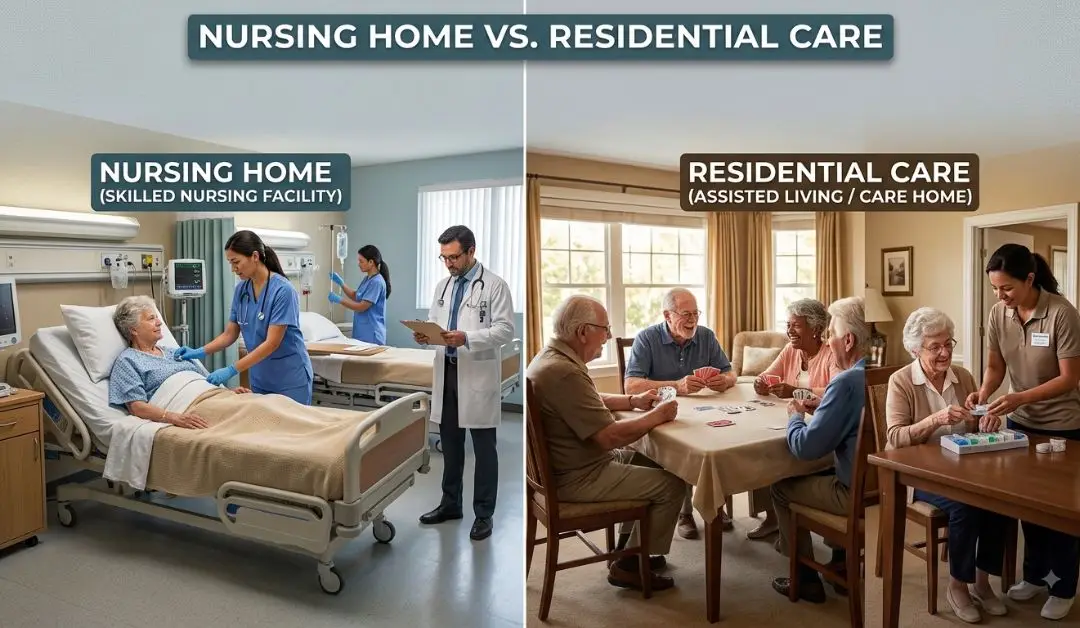
When a parent or spouse reaches the point where living alone is no longer safe, families in the DFW Metroplex are suddenly thrown into a world of confusing senior living terminology. The most common point of confusion we see? Mistaking a residential care home for a nursing home.
Think of the difference this way: placing someone in a nursing home when they only need help showering is like sending someone to an ICU when they just need a checkup. One is a clinical medical facility staffed by doctors and 24/7 registered nurses for complex health needs. The other is a small neighborhood house where 4 to 10 seniors receive personalized help with daily life, bathing, meals, and medications- in a home-style setting.
Getting this distinction right isn’t just about comfort; it prevents overpaying by thousands of dollars a month and helps you evaluate residential care options for seniors based on your loved one’s actual health needs.
What Level of Care Is Provided in a Nursing Home vs. Residential Care Home?
To evaluate residential care vs nursing home options, it helps to look at the exact level of support provided in each setting.
Senior living care generally moves along a simple spectrum based on medical need:
- Independent Living: No medical support, full independence.
- Residential Care Facility: Non-medical custodial care and daily personal support.
- Skilled Nursing Facility: 24/7 clinical medical care and continuous health supervision.
1. What Is a Nursing Home?
A nursing home, clinically recognized as a skilled nursing facility (SNF), is a licensed healthcare establishment designed for seniors with severe, ongoing medical conditions or those undergoing short-term rehabilitation.
- Medical Staffing: Managed by Registered Nurses (RNs), Licensed Vocational Nurses (LVNs), and Certified Nursing Assistants (CNAs) with a Medical Director on call 24/7.
- Clinical Focus: Treats complex medical conditions requiring licensed procedures like tracheostomy care, IV therapy, severe wound care, and post-stroke rehabilitation.
- Environment: Clinical layout resembling a hospital wing or care center.
2. What Is a Residential Care Facility?
A residential care facility (often called a board and care home, residential care home, or RCFE) offers non-medical support inside a real residential house, typically accommodating 4 to 10 residents.
- Care Staffing: Trained caregivers and med-pass certified aides offering high staff-to-resident ratios (often 1 caregiver to 3 or 4 seniors).
- Custodial Focus: Dedicated to custodial care, helping seniors with daily routines like bathing, dressing, meal prep, and medication management.
- Environment: A quiet residential neighborhood home with shared living rooms and home-cooked family meals.
Side-by-Side Comparison: Residential Care vs Nursing Home
Here is how a skilled nursing facility vs residential care facility compares across major categories:
| Feature / Metric | Nursing Home (Skilled Nursing Facility) | Residential Care Facility (Board & Care) |
| Primary Care Focus | Medical care & continuous clinical supervision | Custodial care & daily personal support |
| Staffing Structure | 24/7 Licensed RNs, LVNs, CNAs, Physical Therapists | Trained Caregivers, Med-Aides, Visiting Nurses |
| Physical Setting | Large medical facility/health center | Single-family neighborhood home (4–10 beds) |
| Services Offered | Complex wound care, IVs, tube feeding, intensive rehab | Bathing, dressing, meal prep, mobility help, reminders |
| Primary Payment | Medicare (short-term), Medicaid, Private Pay | Private Pay, VA Benefits, Long-Term Care Insurance |
| Average Monthly Cost (DFW) | $7,500 – $10,500+ | $4,500 – $6,500+ |
Medical Care vs Custodial Care Senior Living: What Is the Difference?
Understanding medical care vs custodial care senior living is the most reliable way to select the proper facility level.
- Custodial Care: Non-medical assistance with Activities of Daily Living (ADLs) such as dressing, eating, grooming, transferring, and hygiene. This is the foundation of residential care homes.
- Medical Care: Clinical treatment provided by or under the supervision of licensed healthcare personnel (RNs, physicians, physical therapists). This is required in nursing homes.
How to Determine Which Care Level You Need:
- Select a Residential Care Home if your loved one primarily needs help with daily tasks (like taking medications, showering, or getting dressed) and does not require a registered nurse on site at all times.
- Select a Nursing Home (SNF) if your loved one needs active medical treatments (like IV drip therapies, daily physical therapy post-hospitalization, feeding tube maintenance, or 24/7 clinical monitoring).
Cost Breakdown: Nursing Home vs. Residential Care Facility
One of the biggest differences between these two care options comes down to monthly expenses and how care is paid for:
- Residential Care Facilities ($4,500 – $6,500/month in DFW): Generally more affordable because pricing covers housing, meals, and custodial care without 24/7 medical staffing costs. These are primarily paid out-of-pocket (Private Pay), through Long-Term Care Insurance, or with VA Aid & Attendance benefits for eligible veterans.
- Nursing Homes ($7,500 – $10,500+/month in DFW): Higher monthly costs reflect around-the-clock medical care from licensed nurses. While Medicare may cover short-term rehabilitation (up to 100 days after a hospital stay), long-term stays require Medicaid qualification or private funds.
When to Choose a Nursing Home Over Residential Care
Knowing when to choose a nursing home over residential care comes down to clinical safety and physician recommendations.
Choose a Residential Care Facility If:
- Your loved one is medically stable but needs daily help with bathing, dressing, or meals.
- They thrive in a small, quiet, home-like environment rather than a large facility.
- They benefit from high caregiver-to-resident ratios and familiar daily staff.
- They have early-to-mid stage cognitive impairment or memory loss but do not need clinical medical intervention.
Choose a Nursing Home If:
- They require 24/7 licensed nursing oversight or complex clinical care (IVs, feeding tubes, advanced wound management).
- They are recovering from surgery, stroke, or severe illness requiring daily physical or occupational therapy.
- They have late-stage, progressive conditions requiring frequent physician management or bedbound care.
Local Senior Care Placement Guidance
When sitting down at kitchen tables with families across McKinney, Frisco, and Plano, we often see families default to looking at massive nursing facilities simply because they don’t realize small residential care homes exist. Unless there is an active medical condition requiring 24/7 registered nurses, a small residential care home gives seniors a true family atmosphere with far more personalized attention. ( Mimi, Senior Placement Advisor at New Day Lifestyle for Seniors).
Frequently Asked Questions
What is the primary difference between a nursing home and a residential care facility?
The primary difference is the level of medical support. Nursing homes provide 24/7 skilled medical care and licensed nursing procedures. Residential care facilities focus on non-medical custodial care, helping seniors with daily tasks (ADLs) in a small neighborhood home.
Is a residential care facility the same as assisted living?
Yes, a residential care facility is a small-scale form of assisted living (often called a board and care home). While traditional assisted living communities house 50 to 200+ residents in apartment buildings, residential care homes operate out of single-family homes housing 4 to 10 seniors.
Does Medicare cover residential care facility costs?
No, Medicare does not cover room, board, or custodial care in a residential care facility. Medicare only covers short-term skilled nursing care or rehabilitation in a certified nursing home following a qualifying hospital stay.
Can a resident transition from residential care to a nursing home later?
Yes. If a senior’s medical health declines and they require 24/7 skilled clinical nursing, senior placement advisors and facility coordinators work together to transition the resident smoothly into an appropriate skilled nursing facility.
Are residential care homes licensed in Texas?
Yes. In Texas, residential care homes (board and care homes) are licensed and regulated by the Texas Department of Health and Human Services (HHS) under Type A or Type B Assisted Living licenses, ensuring strict safety and staffing standards.
Need Guidance Finding the Right Care Home in DFW?
Navigating senior care decisions can feel heavy, but you don’t have to figure it out alone. If you’re exploring options in McKinney, Frisco, Plano, or anywhere across the DFW Metroplex, having a knowledgeable local sounding board can bring clarity to the process.
At New Day Lifestyle for Seniors, our team lives and works right here in Collin County. We’re always glad to help answer questions, tour local homes alongside you, or simply listen to your family’s situation to help you understand what level of care makes the most sense.
Whenever you’re ready, our local team is always here to listen, answer questions, or help you talk through your family’s options.